

Offseason Stealing Signals, Packers & Panthers
Two teams that found success running more than a former me would've said was optimal

I’m going to do things a little differently this year.
In the past, I’ve broken up a lot of my team-by-team research into multiple projects. I used to work through all the projections, and take these extensive notes, and then those notes would help me with the projections podcasts I’d do at Establish The Run with Michael Leone, and then after I got through those two extensive projects, I’d basically start back over with the Offseason Stealing Signals writeups and get those detailed here. With any team-by-team project, there’s a real challenge where you want to go deep into each team, but you find that with 32 teams, that’s tough. The process of researching and projecting and writing about a given team is a multiple-hour process at the quickest, except there’s also an element of processing and analyzing and wanting to chew on the actual takes that are formulating that makes it frankly very difficult to just sit and pound out one projection after another.
When I work through my projections process, I constantly find myself away from my computer. I have this habit of getting up to think. I often head into my bedroom and just pace around by the window that overlooks a street behind our house, for no real reason other than probably there’s more room and natural light than in my office.
Years ago, I’d do the whole thing where I’d be really hard on myself, and think I was procrastinating and those things, but in more recent years I’ve come to embrace that as the good stuff. Cycling through the layers of information and really considering how it pieces together is how you get to the conclusions you want to get to, and that’s the whole point of the whole process. Relative to that, plugging in a bunch of assumptions into a projection so it’ll spit out some fake stats about one possible way a season could go for a team where a hundred assumptions underlying those numbers could be wrong — that part of it feels pretty unimportant.
Anyway, I’ve always thought about my summer as having three major team-by-team projects, where I get pretty pumped when I finish the 32nd team for any of them. Those of you who have been around know the Offseason Stealing Signals posts inevitably wind up pushing into late July and early August, and I’m always trying to get them done while also handling a ton of the breaking news and strategy elements of content creation in peak draft season. That’s never been ideal, but it’s mostly been the product of me not writing those posts when I actually do the projections, because I feel like I’m not working through the projections quickly enough and need to push to the next team right when I finish one, as I try to speed up a process that ultimately just requires time. I’d love to be able to project all 32 teams in one week, but it’s my learned opinion that would require me to not do a worse job analyzing the teams.
Last year, I wrote the first three installments of this series on July 8, 10, and 12, constituting three divisions and 12 teams. But then I was working on other things, including several other posts, and finished up and released the full set of projections, and then I didn’t get the fourth division out until July 26. Then July 31, but I was writing a bunch of other key stuff, and then eventually I wrote up the final three divisions in a flurry on August 7, 8, and 9, though I had a “mega rankings update with commentary” on August 5, a “camp risers and fallers” piece in the middle of that flurry on August 8, and the first Preseason Stealing Signals post recapping the first week of the preseason just a couple days later on August 11. My typical process of procrastinating then trying to kill myself with content is just not tenable, and it doesn’t even make sense because I go such long stretches while doing the projections of not giving you guys stuff to read (hence the random, winding post earlier this week).
I wrote about all this in the first paragraph of the first piece I published in this series last year:
For the last couple years, I’ve gotten started with this series a little later than I wanted to, but wished I got on it earlier. The point of this series has been to lay the groundwork for how I’m thinking about each team before training camp and the preseason, i.e. before new information shakes those baselines up. Unfortunately, because of how the projections process takes several weeks and there are always new teams to analyze, as well as because I’m recording all my thoughts in podcast form with Michael Leone over at Establish The Edge, I often haven’t found time to write the team capsules, and then it’s sort of like having to start over from scratch at the beginning after I get through analyzing all 32 teams.
This year, I was determined to do that in a more intelligent way, where I was writing about the offenses as I worked through them. I haven’t really accomplished that, as I’m now beyond the halfway point of the project (with four of the eight divisions recorded with Mike), but hey, better late than never.
Pretty funny. Anyway, this year I’m going to try it differently. I’m not going to worry about writing up these posts until I have a division done. I’m going to write about the teams as I finish the deep research for their projections. They will be grouped together however the hell makes sense (I’ll make sure to have the team names in the title for searchability). I’m going to do two at a time so it’s not 32 different posts, but as these team breakdowns have gotten more intense over the years, trying to write up four before publishing has been part of what’s delayed the release schedule. I think two is right; I can do a couple projections and then take all these notes I’m writing as I’m researching those teams, and how it all fits together, and just do the full writeup. Instead of different 32-team projects where I finish one then start on the next, I’ll work through these things simultaneously.
You can see how this makes a lot more sense, and I’ve undoubtedly overexplained something here that needed no explanation. I’ll note that I don’t think I’m likely to stick to some schedule where I write one of these every day for 16 straight days, or every other day for 32. There will be weeks where I don’t want to write, and as you know, I probably won’t. At least I’m starting earlier than last year, and hopefully you’ll have a stream of stuff through June, though my kids’ school will end and then we have some travel and I have podcasts and all that stuff will happen.
The key for me today is I want to write right now, about the first two teams I’ve finished, because I’m really fixating on them (even though they aren’t that interesting), and I’ve decided it just makes more sense to write it now. As for what this project actually is, you can read last year’s thoughts, but for this year I’ll break down that idea more as the introduction to upcoming pieces. This one’s already long enough.
Before I jump into the Panthers and Packers, I want to note there’s a theme that ties them together. The way I think of both of them, in different ways, is similar to how I think about the Seahawks’ offense last year, and a few others that make this a real trend.
Years ago, I used to emphasize good research that had been done looking at league-wide passing efficiency on “obvious” and “non-obvious” passing downs. The gaps were staggering. In trying to find it, I found something much, much older, but with similar findings — an LSU blog from 2008 has it that passing offenses had successful plays on obvious passing downs 30% of the time, and on non-obvious passing downs 47% of the time. That blog defined obvious pass downs as second downs with 8 or more yards to gain and third or fourth downs with 5 or more — my understanding is the exact parameters aren’t going to matter much here, because the gaps in efficiency are so large.
The stats I’ve tended to see are things like EPA-based metrics for the QBs, and my big takeaway at the time was we should do a better job of understanding the percentage of a quarterback’s dropbacks that are in obvious or non-obvious passing situations when analyzing their efficiency. And really, I don’t know that it’s that simple, in the way that someone could replicate the effect in every individual situation. I’m thinking of several examples, but the argument I’d make about the why behind this trend, as I wrote about being so important with football analytics earlier this week, is that simply put, when a defense is playing a pass defense, there are going to be narrower throwing lanes, especially for the really high-efficiency downfield passes where extra defensive backs typically means more over-the-top help. A few notes about how I’ve applied this logic before:
In Sean Payton’s first year in Denver, Russell Wilson had decent per-dropback efficiency despite the Broncos running way too much and pretty clearly trying to win in spite of him. People compared his per-dropback numbers to Patrick Mahomes’, in what was a down year for Mahomes, and I argued strongly that what I remember to be a roughly 100-dropback gap in pass intent was the signal. The Chiefs also had a bad run game, and defenses were hellbent on stopping the pass game against them to a degree unlike really any other at that time, while Kansas City’s approach was to trust their star QB and just throw a ton anyway.
In Brandon Aiyuk’s huge year where Brock Purdy was on many people’s MVP ballot, I argued the inverse of the Mahomes thing, which was that what Christian McCaffrey and Deebo Samuel were doing around the line of scrimmage in terms of per-play efficiency forced defenses to make choices where they were committing numbers to the box and deciding to let Purdy try to beat them downfield. He was doing it, and succeeding at exactly what he needed to against easier-to-throw-against secondaries, but it was paradoxical to me that he was in the MVP discussion when defenses seemed to play the 49ers as if he was the weak link in the offense.
In Justin Fields’ rookie year, I argued Matt Nagy only seemed willing to throw on early downs when his trusted veteran Andy Dalton was playing, whereas he was trying to hide his rookie Fields with really high run rates, but that was leading to a high percentage of Fields’ dropbacks coming in obvious pass situations like third-and-longs, and really hurting his ability to find some successful pass plays. This feels somewhat contradictory to the Russell Wilson anecdote, because I’m arguing the QB with fewer dropbacks was actually hurt by that. I want to acknowledge how that may read as cherry-picking, but emphasize I don’t think it is; again, the key is when the throws are occurring, and the argument would be good play sequencers like Payton limit pass volume intelligently, while Nagy would be classified more in the bad category for his approach with Chicago that year.
So there are a few different anecdotes about how high and low volume interact with this, including notes about teammate strength and how defenses choose to attack offenses, which is a key part of this. This is one of those metrics where I don’t actually think ranking the QBs by success in obvious or non-obvious situations is going to perfectly capture the whole trend, because there are these varying elements of how defenses are approaching offenses of different strength.
The relevance to this theme today is I would classify both Matt LaFleur and Dave Canales as good play sequencers who ran more than a younger version of myself would’ve thought was optimal, but I’m not sure if that’s actually true. I think that helped the passing efficiency in both offenses — for the Panthers, it made it respectable, while for the Packers, it helps explain their QB having some of the very best per-dropback metrics in the entire NFL.
Let’s get to their writeups.
Green Bay Packers
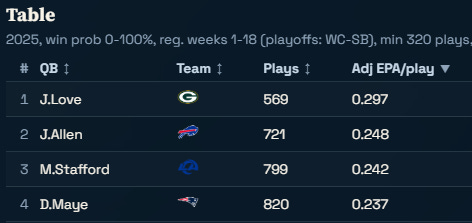
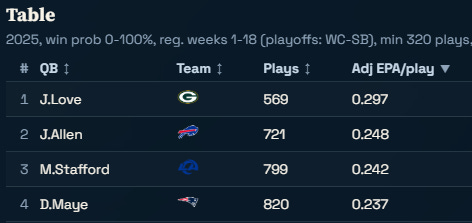
Key Stat: Jordan Love — 0.297 adj EPA/play (led NFL, per RBsDM.com)
Relevant Signals Quote: “If you went in with low expectations due to a prospect profile that had some real question marks, I think it was easy to see how there could be some positives from the rookie year.” (Field Tippers, on Matthew Golden)
Packers Field Tippers pass-catcher analysis
Including the playoffs, Jordan Love’s 0.297 adjusted EPA/play was not just best among the NFL’s QBs, but it was meaningfully better than the other top QBs. A key difference is the sheer volume of plays, some of which is due to missed time for Love and a shorter playoff stretch, but a lot of which is due to team approach, which was perhaps best supported by the even more extreme run-based approach the team took when Malik Willis was under center, and how Willis’ very limited pass volume also featured some elite rate efficiency.
A big part of this is that when Love does throw, he tends to be hunting big gains downfield. But he does that stuff very well, and I’m not trying to minimize the value of that. In fact, it’s the most important element of modern QB play, being able to hit the downfield throws for efficiency. It opens up the whole offense by forcing the spacing with the defense. Simply put, you have to be able to consistently get those throws when they are there, as I wrote about last offseason in relating Jayden Daniels’ great rookie year to some of Anthony Richardson’s struggles, among other things. So this works both ways. People who have Love as elite based on the rate stats do need to reckon with how many of his passes are in nonobvious situations and off play action and those things, versus being asked to drop back in difficult pass spots with the same regularity as QBs on his level (think Herbert, Dak, whose teams tend to live or die with them more). Compared to those guys, the Packers do try to thread a needle with Love a bit more and it does help his efficiency. He’s still obviously very good — the ability to attack vertically and be an efficient deep passer is massive in the modern NFL.
In Love’s first season as a starter in 2023, the Packers were middle of the pack in passing attempts, and he closed that year on a heater. He got hurt early the next year, and dealt with injuries both of the past two seasons, but while I had hope in my projections going into both 2024 and 2025 that pass rate would rise, they were 30th in pass attempts in 2024 and 27th in 2025 (coinciding with the acquisition of a workhorse RB before 2024). Their pace has also been at times too slow, and they have lost some games as a result where they let bad teams slow the game way down and limit possessions; they only got seven possessions in their 16-13 loss to Carolina, for example, and lost a similar game to Cleveland (wind played a role in that one). Those are the types of games where you have to look at them and question the pace and pass rate for how good Love is supposed to be. As we look forward to 2026 pass rate, a healthy Micah Parsons could mean an improved defense, and I have some concerns but do have to acknowledge the futures market has stayed bullish on them all offseason, right at or above their divisional rivals (as of this writing, they have better Super Bowl odds than the very intriguing Bears and Lions at DraftKings, though the Lions are interestingly the favorite to win the division there). I did ultimately project a pass rate closer to neutral, after the Packers were 20th in PROE last year, in part because of Josh Jacobs’ age and some depth questions at RB that could force them that direction, though their expected pass rate based on the market liking them as essentially a 10-win team isn’t high.
Going into last year, I was still reasonably high on Jacobs’ ability to carry the load, as I compared him to other age-27 workhorses who had stayed high-volume at that age, and he was coming off a 2024 where his evasion rates were elevated and near his career high. He did manage a seventh straight season of at least 260 touches, but we now enter age 28 with different advanced metrics, as the evasion stuff cratered to the second-worst MTF/touch rate of his career in 2025. His yards after contact were not great either, and he’s never been a breakaway runner. I do think they will still ride him, especially with limited depth behind him, but he’s a pretty easy fade for me this year coming off declining metrics at an advanced age. Also note that the team’s high run rate plus high average depth of target in the pass game has equated to fewer than 80 targets to the RBs in this offense each of the past two years; Jacobs has matching 36-catch seasons both years, which isn’t great. You do have to like that he’s scored 30 touchdowns over his two seasons in Green Bay, and I expect him to be their top goal-line answer again this year, but I’m not sure that’s upside beyond his ADP rather than just baked in.
There are big question marks behind him, and yet I came to the conclusion both main backup RBs, Marshawn Lloyd and Chris Brooks, are probably decent very late bets right now. Lloyd is the flashy one with injury problems. We don’t have much of an NFL sample, but in reminding myself about his prospect profile, the evasion and breakaway stuff stands out more than the yards after contact or receiving side. This is a change-of-pace runner with flashy big-play upside that could spell Jacobs, assuming Lloyd can stay healthy. (If not, Pierre Strong could maybe fill that kind of role.) Brooks is the more boring backup, but for a minute I felt like he might be the obvious play. The issue is his advanced metrics, dating back to college, which have never been good, and he’s older than you think at 26 so he’s had plenty of time to show something. But Brooks does have size and decent athleticism, and he does everything they need in the pass game, so he could just stay on the field due to dependability, if it comes to that. He’s probably just a bit of a nuisance to the other guys, unless Jacobs misses real time. In that case, Lloyd feels like the clear upside bet, but I understand why the market doesn’t trust him to be healthy. I really like the Lloyd play, but if the market is right about that, you can definitely see a world where Brooks is playing quite a lot of snaps. The uncertainty between Lloyd and Brooks has both outside the top-200 picks despite a run-heavy offense for a good team that has a starting workhorse that’s getting up there in age and showed declining peripherals, and was probably never as dynamic as some of the guys who do keep producing into their 30s like a Derrick Henry or Christian McCaffrey or whoever.
It should also be noted the offensive line has some question marks, having lost starters at LT and C, and replacing them internally, per this FTN writeup I’ve been referencing. In addition to the RBs, the WRs are clearly thinner, though that’s been thought of as a positive in fantasy circles. But with Jacobs older, the star TE coming back from injury, and not much proven depth at RB or WR, what feels great for fantasy could also turn poor if a few things break the wrong way. Again, I’m a bit skeptical of the market predictions here, but I’m also wondering if that’s just the square take and the market is actually right, because I don’t see a lot of people overly excited about this team.
What’s exciting in the pass game is things appear likely to concentrate. Gone are Romeo Doubs and Dontayvion Wicks; one of those two have led the team in targets each of the past three years, with Doubs being the most consistent pass-catcher last year with team highs in routes at 419 and targets at 85. With the way I think of things, I’m having a hard time with his vacated volume in the intermediate depths. I’ve never thought Doubs was all that special, and would explain his rise to No. 1 status here as him being best suited to do a lot of stuff that no one else was really well-suited to do. Christian Watson was great last year as a vertical threat, and he just got a huge contract, but I see that as similar to Alec Pierce where he’s so valuable to the scheme the team needed to lock the guy up for reasons essentially beyond his own target share upside. To wit, Watson’s missed a bunch of time, but even looking at targets per game, his career high paces to just about 100 targets, and last year he was 5.5 per game for just under triple digits on a 17-game pace. As I wrote in Field Tippers, he’s also never posted more than 13.2 PPR points per game even with TPRRs of at least 2.26 in three of his four seasons, which is really strong per-route stuff. He’s also failed to run 300 routes in a season over any of his first four seasons, which doesn’t mean it’s inevitable he’ll get hurt or miss time, but certainly if I have concerns about how an efficient receiver actually translates that efficiency to fantasy scoring on a per-game basis, I don’t also love the missed games. I like Watson, and he’s likely primed to pick up additional volume even if his profile to this point isn’t exactly a perfect fit for it, but I do have concerns this is a profile that’s at too elevated of a price because of the efficiency smash last year. That doesn’t mean he’s undraftable or anything, but I’m hesitant.
Jayden Reed is a name I’ve loved in the past, but there remain real concerns about his route rate. Maybe he’ll start to get used in two-WR sets when the Packers do some heavier-TE stuff, but that’s not been the case historically. One of the fascinating things about Reed, in relation to all the commentary these days about who gets the benefit of running routes in personnel packages with fewer WRs on the field, is he’s been so good on a per-route basis despite basically only ever playing in three-WR sets. I’d say that really emphasizes his overall ability. But I don’t think he’s a natural fit for the Doubs stuff; Reed’s aDOT is lower than Watson’s but mostly because it’s an average, as he does a lot around the line of scrimmage and then also tends to get his air yards on vertical stuff. I like Reed for this year, but it’s tough to love a guy based on per-route efficiency when there are route concerns in the offense and his percentage of routes is also an issue (i.e. basically all the negatives people emphasized last year, and I argued against, but I think I was wrong about, and especially don’t love doubling down on that take after the rise in heavier personnel groups in the 2025 season). But Watson wasn’t the only one to get paid this offseason; Reed got less but got $20 million guaranteed on his own extension.
So then the answer must be Tucker Kraft, right? His aDOT was 4.8 last year, and his efficiency was derived largely from ball-in-hand stuff, as he averaged more than 10 yards per reception after the catch, which is hilarious. I love Kraft, but his TPRR was never high before it started to rise last year, and he’s not really been a dominant route-runner type at the TE position. He’ll be one to watch as I’m probably a bit hesitant with an efficiency guy coming off major injury. Reports have been glowing, but then they always seem to be; I want this profile at peak athleticism, and it’s not just whether he’ll be ready, but whether an offseason of training disrupted by rehab makes it tougher to be at the pinnacle of his particular skill set even when he does return to the field. At a pretty lofty price tag so far this offseason, this is not a bet I’m clamoring to make.
I kinda think the answer to the intermediate target question, internally, might be more about Matthew Golden than the market seems to think. The team has been talking him up since early in the offseason, and then cleared playing time for him. This is a draft-and-develop organization, and I’m reminded of how Doubs himself parlayed an early-career big postseason game into a larger role the next season. Golden went 5-4-84-1 in the Packers’ loss to the Bears, and per Coachspeak Index, Matt LaFleur said this about it: “His final game last year was his best performance, and I’m not even talking about catches or yards — just the play style that we’re looking for from him, he showed a lot of competitiveness. That touchdown in Chicago was pretty spectacular, so I think you got a glimpse of what he’s capable of becoming on a consistent basis.” I wrote in my last piece about how it might be tougher for rookies these days, and including the playoff game Golden’s 1.53 YPRR on 291 routes isn’t horrendous. His YPT was notably strong, with a TPRR of just 15.8%, and we know early-career efficiency tends to lead to more volume, plus the concentration of things and Doubs and Wicks exits leave room for that TPRR to naturally climb. My guess is Golden sees plenty of early-season volume, and maybe he can’t hack it — there were some issues in the prospect profile, and he certainly wasn’t great early last year and lost some playing time when the Packers got healthier — in which case they’d start to rely more on Kraft as he got healthier, and maybe pivot to Reed in two-WR sets. But I think Golden has the inside track for that two-WR role early on, and that we’ll see these offseason moves be an indication the team was ready to feature Golden more in Year 2. With an ADP outside the top 100 picks, he’s an upside way to attack the Packers.
One thing I need to circle back to is Love’s efficiency, and how the wide receivers the Packers let walk were the less efficient ones. Watson, Reed, and Kraft have all been consistently high-efficiency players, and Golden was solid as a rookie. Since receiving stats feed my QB numbers, even regressed numbers for all these guys left me with an initial Love projection that was even higher than his previous seasons of passing efficiency. Put differently, he projects to be throwing to all the guys he had the most success with, and might get more total routes out of them this year than past seasons, so either those guys are going to be quite a bit less efficient (for one reason or another), or Love is going to continue to sustain quite high efficiency, possibly even taking it up a notch. The volume remains the key to what that means for ceiling.
Signal: Packers — pass volume concerns, but some uncertainty there, and available intermediate volume with WRs departing and expected route concentration; Matthew Golden — up-and-down rookie season, but not disqualifying if you had reasonable expectations, and closed the season well with the team seemingly clearing the decks for him to play more in Year 2 (good upside bet); Marshawn Lloyd — to bet on a guy with constant injury issues, it’s nice to believe in the talent (tantalizing prospect data), situation (high run rate on good offense), potential to hit (real concerns with Jacobs), and lack of competition (Chris Brooks is also a decent play as the reliable, do-everything but low-upside volume bet, but it can’t get much clearer among RBs that one has more theoretical talent upside than Lloyd over Brooks); Jayden Reed — good player with some routes concerns, but a reasonable bet at the right price; Jordan Love — high-efficiency pocket passer whose concentrated weapons for 2026 have tended to be the most efficient of the group, so the efficiency scale from floor to ceiling figures to remain high
Noise: Josh Jacobs — 30 TDs in two years with Green Bay (the TDs aren’t noise, but the value of them are, as declining peripherals at age 28, limited receiving, a low breakaway rate, and a lofty price tag don’t leave much room for anything other than the high TD counts and big volume just to be a “small win”); Christian Watson — market confidence he’s the top WR scorer (Watson’s good, but thrives on efficiency, and you’re paying for a role evolution that isn’t guaranteed to come with the same efficiency, or at all, meaning we need to be price-conscious)
Carolina Panthers
Key Stat: Jonathon Brooks — 0.365 MTF/touch, 4.13 YACo/Att, 9.2% breakaway run rate, 1.50 YPRR across college career (all strong to very strong metrics)
Relevant Signals Quote: “The concern is Dave Canales felt he needed to hide Bryce Young with significant negative PROEs, trying to win games by close margins each week, which he was able to do enough to sneak out an 8-9 record and division title despite a hilarious -69 point differential… Concerningly for the future of the offense, even when they got blown out there wasn’t much in the way of late-game production as they tended to just pack it in and take their lumps. They scored 17 or fewer points 10 times in 17 games, and were 26th or worse in points, yards, yards per play, passing yards, and percent of drives that ended in a score. An eruption in their playoff loss was incredible to see, as they tied a season high for points with 31 in nearly pulling the upset (the Rams scored the go-ahead TD in their 34-31 win with 38 seconds remaining), though they still played pretty slowly in that game.” (Field Tippers)
Panthers Field Tippers pass-catcher analysis
The quote above from my breakdown in Field Tippers captured how I felt about the 2025 Panthers. You don’t have to be an expert in Pythagorean principles to recognize when six of your nine losses are by double digits and six of your eight wins are by exactly a field goal, your record was probably a bit unsustainable. What’s funny is in my notes last year, I wrote I thought the Panthers were a good bet for over their 6.5 win total (which I made an official bet at Stealing Lines, RIP), because of a favorable schedule. But now in 2026, they play a first-place schedule, which Warren Sharp has as the 30th-most difficult using lookahead win totals to determine 2026 team strength. Their win total for 2026 is only up to 7.5, and as you’d guess, it’s being bet to the under.
In addition to a tougher schedule for a team that likely got fortunate in one-score games last year, there are some other concerns, like an offensive line that had a lot of continuity going into last year and performed admirably, but has some guys coming off injuries this year. They do return two good pieces in LG Damien Lewis and RT Taylor Moton, and they might actually get more out of RG Robert Hunt, who missed a lot of last year, but LT Ikem Ekwonu tore his patellar tendon last year and they drafted a first-round tackle to try to help there, in Monroe Freeling. Multiple sources do still see this as a plus line, but it’s relevant in that they were already operating on a razor’s edge with the line performing well, and any issues here could hasten the regression.
Weeks 1 and 2 were two of the Panthers’ three highest air yards totals all regular season. After Bryce Young closed the 2024 season well, Dave Canales did come out throwing. He reined it in real quick, and hard. They did push a bit in the playoff loss, as that became their second-highest PROE and second-highest air yards totals of the season, though there were still some pace issues. But for the bulk of the season last year, they went extremely run-heavy, finishing with the sixth-lowest PROE for the season, and finishing at -8% or lower eight times, or roughly half their season. And that’s not just some cherry-picked cut-off — there were six games at -12% or lower, and four at -16% or lower; those four were all among the 24 lowest single-game PROEs for any team, all season, including the playoffs. When you get that run heavy, and you’re also operating at a slower-than-average pace, there’s just very limited play volume. I actually projected them as my 31st team in plays per game last year, and they came in comfortably under that number (in part because my projections are going to be a tighter band around league average than actual outcomes). It’s extreme enough to turn me off, but a big question for me here does become whether there could be some regression if they are just bad, and not trying to cling to a .500 record all year? Maybe falling out of the race early will lead to more stat chasing later in the year? One thing in favor of that is they certainly project to have better pass-catching options than Young has had.
I wrote about it in Field Tippers, but Tetairoa McMillan had a great rookie year given the circumstances, passing 1,000 yards with a 1.84 YPRR driven by both a very solid 21.8% TPRR and very solid 8.5 YPT on 551 routes. He lived up to the prospect hype, and his growth going into Year 2 is a major part of me saying they’ll have better pass-catching options than they’ve had, because I’d expect him to only elevate from here. You want T-Mac stock, but again, the major question is pass volume.
Jalen Coker missed the first six games, then had just 7 catches in his first four back, but had a real upward trajectory late in the regular season once he got healthy, and close with a massive 12-9-134-1 eruption in the playoff game, all season highs. He didn’t earn a ton of volume per-route in the end, but it was his second straight really strong YPT season, and when you depth adjust like I do with RACR for my projections, he looks way more efficient than his aDOT in both NFL seasons so far (in part because of a really high catch rate, which is maybe not sustainable but it’s all really good stuff). This guy’s a good football player, and having him healthy and in the fold for a full season as a secondary piece to McMillan gives Carolina potentially their best ancillary weapon in years, as well. I’m a bit worried about how to play him, because the volume concerns immediately become an issue beyond McMillan, but I do still really like the talent.
Rookie Chris Brazzell is part of the issue for Coker, in that he’s a sub-4.4 guy with actual size at 198 pounds. I have Brazzell pretty easily taking Xavier Legette’s role before we get too far into the season, because Legette has basically just been a size/speed threat meant to keep defenses honest, but he hasn’t shown an ability to produce enough to really press that (he fell to a 0.90 YPRR in Year 2 after 1.19 as a rookie), which helps explain the Day 2 selection of Brazzell. Brazzell’s production wasn’t amazing in college, but his aDOTs were always super high as he was clearly used in a specific role, and he did have solid YPTs despite not necessarily massive target numbers. What you do get is big air yards numbers, with over 900 three years in a row to finish his college career, despite never running more than 400 routes. He had 1,350 air yards and was second in the SEC last year with 1,017 actual yards, leading the conference in touchdowns with 9. Carolina’s GM mentioned his YAC ability post-draft, but that doesn’t show up in the numbers, where he’s mostly just an air yards guy. But that’s good for the scheme, and he has the interesting size/speed profile and has shown an ability to translate it into vertical production. My take on Brazzell as a rookie is more that he complicates things for Coker, probably, and if Legette doesn’t go completely away, the secondary WR targets do feel a bit thin.
One positive for the WRs is the TEs just look bad. Tommy Tremble has five straight years of YPRRs under 1.0 with between 240 and 280 routes, and will likely be involved again. Ja’Tavion Sanders was from a 1.09 YPRR down to 0.83 and continued to struggle to stay healthy, so the upside there doesn’t seem to be materializing. Mitchell Evans was most interesting of the group with a 1.30 YPRR on a tiny routes sample of 132 as a rookie, largely because he did have a very good catch rate and depth-adjusted RACR. But they seem like a team who will rotate TE playing time, and if and when they do some multiple-TE stuff, it’ll be advantageous for the two WRs out there, which does work back in Coker’s favor as he’s pretty likely to be the clear No. 2 alongside McMillan.
The other issue for the WRs is also just Bryce Young, though. Young closed 2024 well, but he was bad enough early that he got benched, so his full-season numbers that year weren’t great. His full-season numbers in 2025 didn’t show much improvement, as his completion percentage only rose a bit while his aDOT plummeted, and his yards per attempt stayed right at 6.3. He threw more TDs per attempt and took fewer sacks, but again we’re comparing to a 2024 where his numbers were supposed to be worse than the level he actually finished at. He set a new career high with 188 pass yards per game, and I’m projecting a pretty big bump to his YPA (in part due to the increase in WR skill) just to get him to about 3,750 pass yards, which is not great. There are a lot of concerns with the overall output of this offense beyond whether Young is good enough, but that’s a major question mark, too. I’m not saying there’s no upside, but I do think it’s fair to tread carefully here.
Rico Dowdle was obviously a big part of the 2025 RB story, and he’s gone, as Chuba Hubbard lost his job then did get some work back later on. Coming off some horrendous receiving efficiency earlier, Hubbard did make a few big plays in the pass game last year, but even with those his receiving efficiency didn’t exactly pop. As far as rushing, his advanced metrics cratered, with a rate of YACo/Att that dropped by more than a yard, a MTF/touch rate down to a career low, and zero runs over 15 yards so a breakaway run rate of, well, 0%. He’s now 27, which is not too old, and I do think the Panthers will be somewhat careful with Jonathon Brooks. But the full body of work for Chuba is honestly not that great; he struggled early in his career, had a couple strong years with 2024 being the best, and now has another tough one on his ledger in 2025.
So let’s talk about Brooks. The Twitter docs seem content with his knee stuff. People are understandably worried, but the Panthers drafted this guy in Round 2 off an ACL in 2024, figuring they might miss all of the first year, then made the early call to give him all of 2025 to get right after the second tear. Obviously the two injuries are a concern, but when it comes to draft capital and team intent and how picking guys early leads to incentive to use them, I feel like the Panthers are almost certainly still looking at this like they want to get a lot out of Brooks before the rookie deal is up. This doesn’t seem like a team that is packing it in and counting the pick as a bust, when they already kind of knew they’d be on a longer timeline when they first took him. And if you want to know why they made him the first RB selected in 2024, and that early despite his rehab, let’s draw a comparison to 2026 top-10 pick Jeremiyah Love. Love had a lot more work in college, which is very important context, at 495 career touches to just 266 for Brooks, but for their careers, Love had a 4.35 YACo/Att rate to a good 4.13 number for Brooks, Love had a 0.335 MTF/touch rate to a 0.365 number for Brooks (both of those are very good), Love had a 10.2% breakaway rate to 9.2% for Brooks (again, two good figures), and Love had a 1.60 YPRR to a 1.50 number for Brooks (good numbers for RBs). Clearly, Love was better, and he did it on more volume. But Brooks’ advanced metrics were like a half tier to a tier below Love, is what I’m saying, and you’ve heard all about how good that guy is as a prospect all offseason. Another thing on Brooks is he was a 21-year-old rookie, and doesn’t turn 23 until July 21, so we’re still talking about a very young guy who is about a year and a half removed from the last major surgery, and we do know that younger people at ages like 22 tend to have more successful paths back from this kind of thing. Frank Gore had multiple ACL tears in college. That was a knock on Nick Chubb. These guys healed up young and then had long NFL careers. I want to be clear that I’m projecting basically a 50/50 split here, not Brooks as some workhorse, because I do think Chuba will get the early work, and then even if Brooks outplays him and earns more later in the year, Chuba won’t go away, because they may not want to push Brooks too hard. Although, that’s tough. When a guy is rolling, you do tend to see teams ride that guy, even when they have injuries in their past. I think there’s real upside here, and the cost is cheap enough right now that he’s someone I’d be targeting, even if the offense might limit the true ceiling somewhat.