

2026 draft strategy guide
Playing the current landscape, with an emphasis on home leagues

Yesterday’s long, winding piece seemed to confuse some, if the comments are any indication, but that’s not particularly surprising to me, in terms of what I was discussing and how I was trying to frame it. If you’re looking for a clear plan, today’s piece is going to be a lot heavier on specifics.
What I will say about yesterday’s piece is I suspect a lot of the confusion stemmed from people who aren’t necessarily as in tune with the past draft strategy writing (which is OK!). I noticed a few of the longer-term subscribers offering helpful notes in the comments, so they obviously felt more confident in the takeaways. But there were a lot of links in there, and I’d suggest if you’re looking for answers to click on a few of those and read the past work. The piece yesterday was pretty “inside baseball,” where I tried to drop a ton of those links so you could refer back to concepts I was building off. (It was also probably just poorly written, as happens sometimes with me when I don’t necessarily have a concept fully formed. Apologies.)
Having said that, it is by no means imperative that you understand the nuances to yesterday’s post. I should have made that clearer. Something I wrote quickly in the intro was I was tying together a ton of different macro concepts I’ve talked about, as the NFL itself evolves, and fantasy football does, too. It was important to talk about how those things come together to create some different strategic pushes and pulls to the foundational elements of draft strategy in what is commonly referred to as the current meta, as the title indicated. But that was important for people who were going to maybe be confused about the “why” to today’s piece. If you just want the strategy, that’s more of what we’ll do today. Yesterday’s piece was just talking about the landscape we’re playing in, and how that influences draft strategy; today’s is the breakdown of that actual strategy.
I decided to do it in two parts because I’ve done that before. Back in 2023, when I first wrote this “home league strategy guide,” it was in response to years of reader feedback that my strategy guides were too fixated on higher-stakes formats and were out of touch with normal leagues. The questions weren’t rude, but they basically said I was describing drafting parameters where there was more stress on certain areas of the draft, and then you guys were finding that the tiers wouldn’t run out nearly as quickly in softer “home leagues.”
Naturally, the question was if you could wait a round or two longer for something I was stressing needed to be accomplished by Round 7, or if a WR Window I was talking about closing in Round 9 had some guys lingering around that you could scoop up into the Round 11 and Round 12 range, how would that impact some of the early-round strategy?
In that 2023 season, I wrote a somewhat impromptu piece about the “meta,” as it were, where I argued that the key range of drafts was essentially the early RB Dead Zone, in Rounds 4 and 5. I talked about how in the past, as far back as 2016, I’d written about this concept of “working back to front,” meaning thinking through what you can accomplish in later rounds of a draft to inform earlier-round picks (so you’re well set up to take advantage of where you see value later and build an overall roster you feel good about). But in 2023, I asked whether we should work from “the middle out,” as that Dead Zone range was so important to the questions in the first few rounds and then also how we played things later, obviously, because your early-round strategy will always inform what you do in essentially “Quarter 3” (since Quarter 4 should be thought of more as flyers you might churn, Quarter 3 is that last opportunity to make super impactful decisions for draft strategy).
If you’re not familiar with the quarters concept, I wrote a conceptual piece that simplified the ranges of a typical fantasy draft into four key areas with different objectives. I called them “quarters,” but they aren’t equal in size. I’m going to use that framework a lot today, because I think it’s very instructive to the issue of building draft strategy in 2026, so that’s a piece worth revisiting to better understand today’s piece, but I’ll also review the ideas below.
Before I get there, I want to finish the thought about 2023, and past versions of this guide and how it has evolved. That year, I wrote about drafting “middle out,” and the next day I realized how that framework would be particularly powerful in these softer, “home league” settings, so I wrote the first home league guide, and worked toward a section titled, “Having your cake and eating it, too,” that detailed a specific draft plan that made 2023 quite attackable based on ADP that year and where the values were. I used that strategy in my own leagues, including at the high stakes level, and wound up with three really great finishes in the top 30 overall of either the FFPC Main Event or NFFC Primetime tournaments, including a top 10 in each.
In 2024 and 2025, I’ve run back the home league guide, but it was more about broader draft strategy I tried to make applicable across all leagues, and yet I also got caught up in trying to be too precise, so people could follow a sort of step-by-step blueprint. The successes of 2023 were more organic, built from my analysis and how that would then apply, whereas the approaches in 2024 and 2025 were I think very sound bets, but more about trying to produce content a certain type of way, and that’s not where I’m at my best. So this year, I’m just going to talk about draft strategy, but then I will certainly focus on home league realities that I know are most relevant to most of you. It’s all tied in; I can’t write different strategy guides for every league type without it all being super redundant, so the guides over the past few years have basically tried to hit on everything, anyway.
Putting that differently, I need to talk about the concepts and not worry too much about simplification; I understand some of you are hoping for a step-by-step guide to winning your league, but my job as an “expert” is to tell you that’s not actually what you want, because it doesn’t actually exist (or at least not every year; 2023 was a rare one, and I’ve never really experienced anything like that in other seasons in my now 11 years doing this). Every league is dynamic, and what you actually want is a deep understanding of how to play fantasy football this year, so you can make smart decisions when you’re on the clock, across different league types.
By way of further explanation of this point, and to also start hitting on some of the strategy we will cover for 2026, I want to review some of the very specific strategies in last year’s guide. One of the long-term ideas in home leagues is because the formats are softer, you can prioritize your starting lineup a bit more, which largely means you can make more “detours” in the early rounds at the expense of depth at positions like RB and WR. Last year, I especially felt there was value in the very elite TEs relative to the rest of the landscape, and had Brock Bowers as the priority but Trey McBride in a Tier 1b situation as the only other guy up there with him, before a “Big Tier Break” as I wrote it. Here’s how the top of the TE tiers article looked last year, with two Targets in their own tiers.
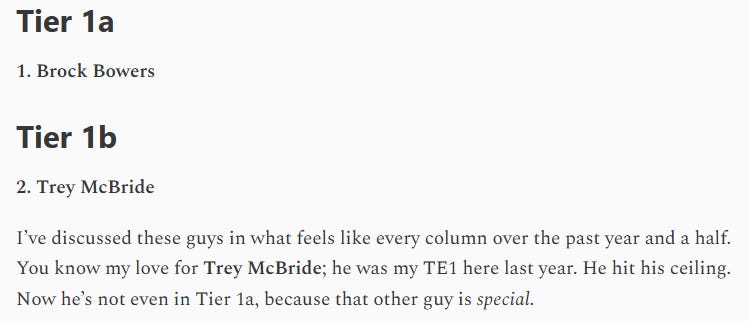
I wrote McBride “hit his ceiling” in 2024, but that was more in reference to a rough ceiling with Kyler Murray, who only played five games. You know the rest; Bowers had the injury season and McBride went on to gap the position by over 100 points in PPR leagues, posting 316 while only one other TE (Kyle Pitts) hit 200. Additionally, hits at other positions in the early rounds made the opportunity cost of Bowers a damning misstep.
The analysis of the TE landscape was unquestionably correct, and the fact that Bowers is still the 2026 TE1 further validates, in my opinion, that even the ordering was correct. (It’s a bit shocking, honestly, that the 2025 result has not given McBride more deference, given Bowers has some of the same team-level issues McBride does in 2026.) But the specifics of the Bowers play were brutal to success last year, because as I wrote about yesterday, the early RBs and WRs were the ones who scored all the points.
Some of you did wind up with McBride, but far more were able to get access to Bowers in these softer formats, and did, often pushing him up a bit to achieve the perceived structural benefit, per my recommendation. A few rounds later, after a couple years of not considering early QB enough in these softer formats, the recommendation was clear: grab one of Lamar Jackson or Jayden Daniels for their full-season upside that could gap the rest of the QBs. That was even more damning since there was no McBride outcome; it didn’t matter who you got, you were in tough shape, particularly because you needed that early capital for RBs and WRs.
I wasn’t naive to the risks of taking multiple onesies early, and did discuss them. I remember years ago, maybe in my first five or so years playing in higher stakes, hearing a general heuristic from a longer-term high-stakes player that taking both an elite QB and elite TE in the first six rounds was a no-no. But that was in high stakes. I grappled with the impact to the rest of the build to use so much early capital on the onesies in home leagues, but the idea with home leagues is you can make those kinds of bets. I do stand by the theory it could’ve worked; we know that QB1 scored at levels way below recent seasons, and a real ceiling from a healthy Jackson or Daniels actually would’ve probably been similar to the McBride effect last year. Drake Maye was good, but he was better because there was no ceiling; he was more like the Pitts of TEs, except there was no McBride season.
I recognize that it might feel like I’m meandering again, like it felt to some of you yesterday, but in 2026, when many of the conceptual frameworks for “structural drafting” are table stakes, and I’ve been writing about them for a literal half decade, understanding the difference between process and result is crucial. Why did we do the things we did, and what can we learn? You never want to over-rotate. It’s entirely possible that the early QB thesis could hit this year. I’ve done it over multiple fantasy seasons before, where I missed on a concept one year, and then over-rotated, and then missed again as my original thesis was accurate and the flop lag hit in Year N+1. It’s imperative we keep our eyes forward, but we still have to understand the past. That was the whole point of the TreVeyon Henderson section yesterday, where my argument was people weren’t properly valuing the result, based on what actually matters to winning fantasy football leagues, when they knew it (and I could still be wrong there, that was just my argument, but it’s important to frame all of this stuff).
Anyway, I tried to lay out a very specific plan last year, and it didn’t work. Part of why it didn’t work was most strategies didn’t work, as I wrote yesterday. The whole landscape was full of misses last year, and I fascinatingly still had my most profitable season-long season as a fantasy player because of some good fortune in my higher-stakes leagues, despite way more Bowers exposure than McBride, and a lot of Daniels and Jackson sinking my own teams. The idea that everyone’s teams were bad prompted me to write a piece at the end of the season called, “Every process has holes.” Again, important groundwork to understand for future draft strategy.