

Free agency round-up
Recapping one of the best weeks of the year

The tampering period before free agency officially opens is always a wild few days, as we get a million deals reported that were clearly agreed to before the tampering period. But also, nothing can be finalized.
There’s also the element of deadlines spurring action, so get trades layered on top of the free agent deals, and a combination of these things led to that huge Maxx Crosby trade falling through, which had reverberations around the league.
There’s just so much happening right away, and then each day there’s more, though it does trail off. As always, I love to throw out some early responses to this stuff, mostly from a vibes perspective of how well I think the teams are doing and how different players could fit. That stuff is especially important in a 2026 where scheme is more important than ever, and more than half the league’s teams have major coaching changes at the coordinator or head coach levels. Some of these teams going a new direction are going to fall flat on their faces!
Last year’s post opened with a note about the work the Bears did in the trenches on both sides of the ball, which wound up being a key observation in a 2025 season where they went from worst to first in the NFC North. Last year’s post also famously questioned the way Seattle was building, something I’ve spent the past year unpacking as they have been a fascinating microcosm of everything happening around the league.
There were some other valuable hits, a few of which were about veterans as bad fits that feel obvious in hindsight, which is what happens when you look back at correct analysis with the benefit of a hindsight where we saw that analysis play out as accurate. There was more that was quite humbling, and the misses do just feel more jarring because it’s like, “Well that sounds absurd, how could you have even considered that?” We’re always biased by the things we do see — it’s basically impossible to control the results-based elements of your brain, and keep from putting extra weight on the outcomes that did occur than they deserve in terms of how likely things were to have gone that way either beforehand or even after we learned the specifics.
Anyway, I don’t think today’s post is going to have a bunch of answers, and as always, I don’t want to get anchored to early offseason analysis. I like doing content this time of year, but I realize that a lot of people consuming it are already drafting in a major way, and they want finalized takes. I try to bridge that gap, but my obligation will always be to accuracy, and broadly my belief is especially this early that should take the form of emphasizing uncertainty.
But here are some of the things I have thought about most strongly over the past week. You can also hear Shawn and I discuss several of the early free agency moves on this week’s episode of Stealing Bananas.
Trade discussions add weight to suggestions the NFL is down on this rookie class
This isn’t directly related to fantasy as it’s more about depth across all the positions, but DJ Moore fetching the 2026 second-round pick both reeked of a bit of desperation from Buffalo, and also felt like a tacit admission the WR answer Buffalo was seeking wasn’t going to be available in this draft, where they wanted to be able to take him.
Then the Maxx Crosby agreement landed, and the Ravens were hit pretty hard publicly about the cost being two first-round picks, and that perception of paying too much in some ways probably informed the responses that they got cold feet when they eventually walked away. There does seem to be something there, but just starting from the initial agreement, I think their internal calculation probably devalued the 2026 first-round pick, and then felt like the 2027 one might be late, and that was probably why that felt a little lofty. (As far as their stated reasons for backing out of the deal, I don’t seem to understand all the specifics, but I do struggle with this idea they viewed Crosby and Trey Hendrickson as interchangeable; opinions seem to assume they were happy to move off Crosby and pay Hendrickson because they just had a generic need for an edge defender. But there are some who believe Hendrickson has potentially gone over an age cliff at 31, while Crosby is more than two-and-a-half years younger at 28 and is said to be a meaningfully better run defender in addition to a high-level pass-rusher, so I think the initial trade agreement strongly suggests they just valued Crosby the player differently than Hendrickson. Everyone wants a conspiracy theory and there have been a lot of anonymous quotes out there — plus Baltimore commenting they were potentially going to acquire both and pair them, which seems hard to believe relative to their cap charges — so again there’s more here than my explanation covers, but I guess I probably think there’s also a reality to the surface information that they actually did want to acquire Crosby for that cost and actually did find his medicals to be more concerning when they got in there, than what they understood about them from the information they were working on during negotiation. The ideas they got cold feet without new information and made up an issue, or were acting nefarious from the start, both assume a lot more when you peel back the layers of those claims.)
Anyway, I could be wrong on that, but that’s why even a voided deal is still relevant to me for this point that teams do seem to be pushing 2026 capital. Another data point is that the A.J. Brown deal doesn’t appear to be getting done, and everyone is rushing over each other to point out that was always a much more difficult deal to get done before June 1, but this is again one of those outcome bias instances. Sure, it was always unlikely, but if you think all the reports of negotiations this week with multiple different teams were all fake, I think you’re naive. Additionally, take the Eagles’ behavior with Dallas Goedert, where they have been mutually pushing back his void dates, something that can really only be explained on these terms that they supposedly can’t keep both Brown and Goedert responsibly. I think the Eagles actively tried to move Brown, even before the June 1 date, so they could more easily retain Goedert. But the hang-up seems to have been their asking price in picks, which I’m reading as them again devaluing 2026 capital and feeling like they should be overpaid relative to the strength of this class. Maybe that’s too many assumptions on my part for Occam’s Razor and now I’m the conspiracy theorist, but at the least there appears to have been disagreement on price, which for the Eagles might not have been about the 2026 class but just about this idea that if they were going to deal him here in March, the much more damaging dead cap situation meant they felt they were owed additional compensation. (Or that teams felt they were in a dire situation and could prey on them to some degree, which they wouldn’t accept. Who knows? But the answer there was never a path to Brown being dealt here in March because of his contract is I think pretty clearly an oversimplification when everyone knew the contract hurdles and yet there were still real, valid reports.)
You could make a case there are unique elements to the Crosby and Brown non-trades, and that the Bills were just desperate for a WR, so I’m connecting too many dots here about trade compensation vis-a-vis the strength of the 2026 class. But some of the rumors floating around about what was being offered for Brown and how the Eagles wanted even more were surprising to me in terms of being quite high, and so there’s a trend here where it feels like the draft capital has been a lot this offseason despite the league seeming to acknowledge over time that selling tons of picks for older players due a lot of money is bad business, when you consider the value of not being certain you’ll hit on every pick but amassing enough picks such that you do hit on some and have some young, cost-controlled talent when those hits occur. Every roster needs that type of surplus value, and I’ve felt the NFL has been trending toward more of an understanding of that, but so far here in 2026 it’s felt like this is not an offseason on the trend line, and for me personally that’s been a negative commentary on a rookie class where they seemingly expect fewer hits, and less pressure to hit this year’s draft with pick volume versus the potential of using it to acquire “sure things” they have more confidence will contribute.
Ken Walker and Alec Pierce provide interesting team-building contrasts
Free agent deals always require big money commitments, but one of the realities is there is a difference between paying top of market at premium versus nonpremium positions. One of the major reasons people talk about RBs being tricky picks in the top 10 of the NFL draft, is the rookie contracts are determined in advance by pick slot, so you don’t get any discount there. Frequently in recent years, the highest-drafted rookie RBs have immediately become some of the highest-paid players at their positions.
Meanwhile, if you pay a top-of-market free agency deal to a RB, like the Chiefs did, you can still get a meaningful discount to, say, what the Colts paid Alec Pierce. Pierce is set to average $28.5 million over his new deal, which is one of the higher AAVs among WRs, and in my opinion an overpay for a player of his skillset (and yet, perhaps a necessary one, I’m not exactly sure about that; to me, his skillset is unique to what’s valuable to make offenses tick, and if he remains efficient and maybe even adds some more work in intermediate and shorter ranges as opposed to mostly being a deep threat, it would be fair to suggest that if he was making like $20 million per year he’d very much be worth that, so the question becomes a marginal one about the tax on free agency and how else you’d use that other $8.5 million you had to tack on; not everything is purely about efficiency when alternatives are limited; Pierce’s fantasy prospects don’t come close to justifying that contract value, for what it’s worth, but his ADP isn’t going to place him in the top-10 WRs like his contract does, either).
Anyway, Pierce’s $28.5 million AAV dwarfs what Kenneth Walker got, which was a $14.35 million AAV with double that number ($28.7 million) fully guaranteed. Both contracts are relatively easy for the teams to move on from after two years if they don’t work out, but Walker’s more so, as Pierce would get into some of the post-June 1 stuff and have a little more leverage to potentially negotiate a favorable restructure, it seems to me.
Given these two deals, and looking at it from the perspective of a team like the Chiefs with a pick in the top 10, you can see where the prospect of paying Walker in free agency and drafting a WR makes more sense than trying to pay a WR in free agency and draft Jeremiyah Love, even if Love feels like way more of a sure thing than any of the WRs in this class. That’s not to say argue plainly that Love doesn’t belong the top 10, either — I think that’s tough to justify, certainly, but I do think a dynamic RB has real value in the modern NFL, so I’m at least more open to the suggestion than I was a half decade or more ago. But the thought there is with a full acknowledgement that you create thin enough margins that you just have to be right the player is truly a game-changer, as well as the available WRs being guys with some real warts, because consider what Walker’s record-breaking free agent RB deal cost Kansas City versus what you could buy for that price at WR. In any circumstance where you can get a real WR hit in the draft, you’d just much rather take the free agent RB plus the rookie-contract WR.
Walker to the Chiefs is obviously exciting for fantasy
The way defenses play the Chiefs creates daylight to run to, and Walker is nothing if not dynamic when he gets into space. The ways people thought Isiah Pacheco were good were mostly due to the offense putting him in good spots, and Pacheco having the athleticism to take advantage of that to a degree. Walker would be like a supercharged version of that as a guy who is always hunting home runs but should have more room to find them.
The impact could be a bit like James Cook in Buffalo, even if Walker is maybe not as good of a success-rate runner as Cook. That said, there’s great data I’ve seen a few places, including from Shawn on Stealing Bananas, that argues that Seattle’s run scheme led to not just Walker but also Zach Charbonnet being contacted behind the line of scrimmage at super high rates, and then that not happening to Pacheco during his tenure in Kansas City.
And that’s why the fit is so great both for the player going to an offense that utilizes his strengths and the team finding a guy their situation can maximize. Walker does have some tendencies to bounce outside and can get himself into trouble, but if you have Patrick Mahomes threatening defenses the way he always has, you can live with a RB who has that downside when the associated benefit is an open-field skillset with elite evasion metrics that is tantalizing in a situation where you can probably get him into space more frequently than he’s been in throughout his career.
This is the kind of move Kansas City has needed to make to help unlock their offense for quite a few years now; if Walker can create explosives on the ground, it might even start to open up some of the passing lanes, after defenses had to give absolutely no respect to guys like Kareem Hunt last year.
Kyler Murray to Minnesota could go a couple ways
My priors here are Kevin O’Connell is a good coach, JJ McCarthy is legit pretty awful, Sam Darnold was good at both places the past two years because they were both above average spots to play, and then Kyler Murray’s skillset is concerning in the new era of the NFL, as he’s always relied on his athleticism for answers to some of the toughest questions defenses throw at him, and has seemed to struggle with the particulars of just standing in there and being a pocket QB, quite likely because he’s just not a very tall NFL QB, all jokes aside.
Given all that, and given what happened with Trey McBride as soon as he got a different QB in there and suddenly went for 11 TDs to tie for the league lead after people thought he legit couldn’t score despite a skillset that always seemed like that was super hard to believe (and how that argues Kyler was the problem), I don’t really have a ton to say here.
What I believe is Kyler is immediately an improvement on the QB play the Vikings got in 2025. See if you can spot the outliers in Justin Jefferson’s per-route profile since his rookie year, where he’d been a 2.50+ YPRR guy every year until 2025.
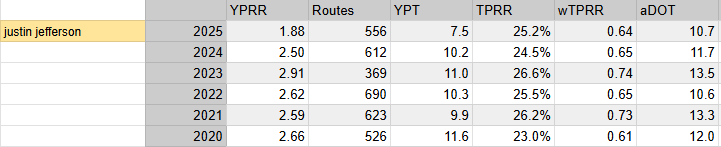
That dude’s a superstar, and if you push him down to a 7.5 YPT and prevent him from even being a 2.0 YPRR guy, I mean that’s on you as a QB. The only stuff they could even coax out of McCarthy by the end of the year was throwing to third-string TEs on designed leak plays.
Murray had his struggles with McBride, but was at his best earlier in his career working with DeAndre Hopkins, who did produce solidly in Arizona relative to expectations at that point of his career. He wasn’t perfect at all times, but he played hurt a lot of that period, and has been mostly pretty done since leaving there, so contextualizing where he was in his career is important. Jefferson right now is a step up as the best WR Murray has worked with.
And Jordan Addison and T.J. Hockenson are very good ancillary pieces, as well. This is a very good situation to throw to. O’Connell I do believe will scheme it up well, perhaps the best Kyler’s had to work with in that regard, as well. I don’t think Kyler is completely incapable of legit passing production. I think there are people that go to far on that, because of his height, but he’s always had more passing ceiling in the past data — including one of the most efficient collegiate seasons ever at Oklahoma, and some of his early-career NFL stuff — than people credit him for.
But I also see ways where this just doesn’t work for him in the modern NFL. It’s all super cost-adjusted. I was on FFT Dynasty with Heath Cummings yesterday, and he asked me some one-for-one QB values in dynasty like Bryce Young and Tyler Shough that afterward had me thinking Kyler was a pretty easy buy in those price ranges, because to me those are QBs whose coaches were mostly hiding them in terms of run rates and probably aren’t going to put up real fantasy ceilings anytime soon, and I do think the overwhelming probability is Kyler’s the starter for Minnesota this year and then the scoring level probably is meaningfully better than that, so from a dynasty lens you’re talking about at least gaining value by this time next year.
What I guess I’m saying there is I do think there will be some passing efficiency and production with skill guys this talented, and then he’d still be expected to add real value with his legs in any situation because that’s just sort of inherent in his profile. That plays up in fantasy, butt I guess I don’t know how high the ceiling goes, both for fantasy and for the Vikings. This was already one of the most fascinating teams to evaluate for 2026, because of the degree 2025 deviated from expectations for individual players and the team as a whole, so throwing Kyler Murray in here — one of the league’s biggest enigmas at its most important position, off a season where he only played five games and we really don’t know what we have — really just ratchets that up. The biggest thing I’m left with is I’ll want to play this very relative to cost, all offseason, across formats.
Mike Evans mutes my enthusiasm for Ricky Pearsall
Mike Evans isn’t young, but we’re talking about maybe the most consistent volume earner at downfield depths of the past decade. Evans has always had remarkable TPRRs for his aDOTs, and that was sort of what was intriguing about Ricky Pearsall’s 2025 where he got to an 18.2% TPRR at a 14.0-yard aDOT.
Evans in 2025 was at a 26.0% TPRR at a 14.4 aDOT, though there are important notes. There’s a small sample of routes here, and his efficiency fell off the face of the earth on that sample, so if you’re worried about Evans being good you kind of have to make a small-sample caveat on the efficiency side that makes it hard to then ignore that his volume was at a multi-year high. In other words, I certainly wouldn’t expect that type of small-sample per-route volume in a whole new scheme.
But what you’re definitely talking about here is overlapping depths, and I’m just more confident in Evans’ longer track record than Pearsall’s, even at an advanced age. It doesn’t make Pearsall uninteresting, but the 49ers have a new major piece to go along with Pearsall and then the elites at RB and TE (when healthy), so it does get crowded fairly quickly again and the questions about Pearsall being a volume-earner or just one who benefits from schemed-up stuff start to become pretty concerning. I do still like Pearsall’s efficiency, though Evans potentially being Kyle Shanahan’s red zone answer to what Sean McVay was doing with Davante Adams last year feels especially problematic for Pearsall a year after he scored zero TDs (in his own small sample).
So far in his career, Pearsall’s been more of a chunk-yardage guy but some of those concerns about his route-running precision seem to limit him to between-the-20s big plays where the field is more open and they can kind of run him into big areas and just use his athleticism. I’m probably being overly precise about that, but man, Evans’ red zone dominance feels especially notable. I mean, the reasons you bring in Mike Evans feel like direct attacks on what I’ve thought were potential real limitations for Pearsall, that I was just starting to look past.