

Processing is the key to modern QB play
The mobile QB bubble popped

I started on the promised “5 ways 2025 was a transformative NFL season” post, but the first trend that defined this season really just needs to be its own post. It needs to be written first, but it got too long that it threatened to bury everything else.
I already covered the drastic drop-off in high-end rushing yardage at the QB position in 2025, but the “real football” reasons go deeper (and there’s no shot I understand them all). The best stats from that other post that emphasize the rushing drop-off were: “In every season since 2017, there have been at least three QBs over 500 rushing yards, until 2025, where only (Josh) Allen reached that plateau.” And: “Allen’s aforementioned league-leading rushing number was 579. That’s the lowest number for a league leader since David Garrard led the league’s QBs in rushing in 2009.”
This shocked me particularly because QB mobility has been an emphasis over the past 10 years. Some quick examples would be the draft statuses of Trey Lance and Anthony Richardson in 2021 and 2023, as two players who essentially can’t throw the football accurately but are elite athletes with big arms and that was enough to make them both top-five overall picks in a span of three years. Go back to 2019 and you get Kyler Murray as the No. 1 overall pick even though he maybe literally can’t see over the line of scrimmage.
This is one of those trends where you almost think about it like over-regression. The pendulum swung back beyond the midway point, in short order, and now the emphasis is squarely on processing. Philip Rivers came back five years after retiring, and Joe Flacco has been bouncing around and providing a bit of a floor to bad offenses for the past few years, and look Rivers wasn’t good but the point is he had no business being as good as he was. Steve Young was out here talking about how he could play some snaps and still process what was happening, because that’s the thing that’s like riding a bike. He’s 64! But this is the thing all close observers have tended to agree on, and it’s what Tom Brady has gotten right as he’s emphasized the lack of development at the QB position.
It’s also why QBs who busted are finding success years later, because this position is frankly all about figuring out the mental part before the physical skills start failing you. We’ve for years seen old QBs play some of their best ball, whether that was Brett Favre on the Vikings, Peyton Manning’s late career with the Broncos, or the stuff Brady did in his twilight years that made people forget that through his 20s he was very, very good, but never really considered even the best QB in the league at any time, which I only note because of the recent Bill Belichick discussion and me continuing to hear nonsense like “Brady made Belichick” from people who clearly didn’t watch football for the entirety of the 20 years they spent together (not trying to knock Brady; the obvious answer is there was a symbiosis there which explains the massive levels of success, and yes that means Brady benefitted from having a guy known as a football encyclopedia as the biggest constant throughout his career, which I’m talking about now because again I’m making the case this position is about the accumulation of knowledge before the physical skills decline, and no one embodies that better than Brady, who for what its worth deserves pretty much sole credit for his own longevity because of how well he took care of his body and extended that physical peak so he could be even more lethal with the additional knowledge he had over basically every other QB ever in large part because of, again, the Belichick influence).
Anyway, where we are now with the ways defensives have shifted just in the past half decade, which we talked about in the intro, challenges this skillset most aggressively, changing the looks pre- and post-snap, and rolling things and acting so chaotically that even when teams look back at the film, or definitely are looking at the images on the sidelines during the game — they can’t figure it what they were going against. Gameplanning between weeks has to be harder than ever. There have been discussions about defenses being intentionally unregulated just to throw off the understanding of their rules. Tendency breaking. I’ll always reference that podcast series from The Athletic called The Playcallers where we got direct quotes from the league’s foremost coaches in the Shanahan and McVay tree. Wrote about it a bunch at the time. Here are those pods if you’re curious; they did more in 2024 that I don’t think I ever got around to listening to, but the initial five-part series from July 2023 is amazing content for this discussion. When I bring them up, I often mention Sean McVay saying he wishes defenses would play things perfectly, because that’s something he can analyze and beat. But he used that term “unregulated” to talk about how amorphic things were getting.
So much of the game of football is about the planning. You scout your opponent, you try to self scout to learn your own tendencies, and you make a gameplan. A good gameplan will try to exploit weaknesses in the opponent, but it will also try to understand one’s own weaknesses, and how they may be attacked, so they can potentially use misdirection or other things to improve the situation. I’ve told a story before about an old segment from that ESPN NFL Matchup show with Ron Jaworski and Merril Hoge from probably the 2013 season where they broke down Peyton Manning throwing about a 2-yard TD to Wes Welker, in about Week 8, but to do it they went back to a TD from about Week 2, and it looked identical, with the same formation, and Welker ran that quick, in-breaking route Manning loved at the goal line where the WR would catch it a just a yard beyond the goal line — he went to that play in Indianapolis for years, especially in the later years, so probably more with Reggie Wayne than Marvin Harrison, Sr. But when the show went back to the Week 8 to Welker, what we saw was a cornerback who had done his homework, and broke on the route hard, and was there to intercept it, except Manning and the Broncos had also done their homework, knowing their own tendencies and probably that because it had been like six weeks, the defender would be confident he had something the Broncos didn’t realize they were giving away, when they came out in that same formation and Welker started on that hard inside dig. But Welker’s Week 8 route was a whip — that fake dig that spins underneath into an out. The cornerback overpursued by a mile. It was an extremely simple lob to the outside for Manning for a TD.
That whole play was made possible by a man coverage look at the goal line, but it gets at this concept of how much of the game is about the planning. And it was a necessary tangent so I can further emphasize that you can’t plan for something you can’t identify even after the fact, because of the appearance of a lack of structure. You don’t even necessarily know what the rules were — who was supposed to cover what, or whether they were just showing something or actually doing it — especially in the areas of the field that you didn’t necessarily attack (say, because you went to the one-on-one they gave you on the other side of the field).
That’s what quarterbacks are faced with today. That’s what Sean McVay lamented a couple offseasons ago, about the lack of regulation. I’ve written this stuff before, and I continue to write it, but it explains what you saw in 2025 vis-a-vis pocket passers and mobile QBs. I don’t know exactly how defenses are evolving, but clearly they are getting even better at this stuff. They remain ahead. They’ve seemed to really take away QB mobility, for example. Even for guys whose rushing had been pretty consistent, like Jalen Hurts, we saw a steep decline in 2025, as I wrote about in the positional trends piece.
If we rewind just a little bit, to when defenses started the shift we talked about in the intro, and are talking about again here — and that has been just in the past half decade — the focus on QB mobility seemed obvious. They started to drop more players into coverage to take away explosives, but QBs with mobility created more dynamic rushing games that kept lighter fronts in conflict. In 2022, that first year scoring was down leaguewide, Justin Fields ran for 1,143 yards, second most for a QB all time. Four other QBs broke the 700-yard plateau. (Remember what I said a minute ago about there being at least three QBs over 500 most years? Well, 700 yards is a different story. There have only been 24 QB seasons all time that went for over 700 yards. Five of them, more than 20%, came in that one season, just three seasons ago.)
When I say in the above subheader that the mobile QB bubble popped, I want to be clear that I’m not saying I believe we’ll never get big rushing yardage seasons again. What I’m saying is you have to be able to do both. We’re back to where mobility has to be a plus, not the main sell. The stuff that plagued Lance and Richardson extended this year to the Murrays and the Fields of the league. The way I’ve described this is it’s not the case that mobile QBs fundamentally can’t read and process the types of disguised secondaries I’ve been discussing, but that they are at a disadvantage merely because of their athleticism — they didn’t reach the NFL purely from developing those skills like the pocket passers had to, because they had their athleticism to bail them out at various points.
It’s really hard to understate this point, because of how important the key downs are to successful football, and how different passing success rates are when we talk about obvious passing downs like third-and-medium or third-and-long. If you have the athleticism all through high school and college where you have other answers on those key downs, and you’re able to use superior athleticism to pick those downs up and keep drives alive, you are going to a) do it, and b) force defenses to defend it in a way that quite simply changes the coverage math.
And again, I’m not saying mobile QBs can’t develop the important processing skills, but simply that all evidence points to more time on task assisting that development, and what I’m arguing is the athleticism in some way is going to detract from that starting at a young age. This is not to shit on mobile QBs as much as to circle back to a point I made about the most accomplished QB ever, when I argued Tom Brady’s career as being helped by the wealth of knowledge that was Bill Belichick, and how he played quarterback at a seemingly upward trajectory from Season 1 right up until maybe not the very last season but probably the ones prior — he won that final Super Bowl with Tampa at age 43, threw for 40 TDs just three times in his career and two came in his final three seasons, and he also threw for a career-high 5,316 yards in his penultimate, age-44 season.
If Tom Brady was still getting better at age 42 and age 43 — and he’s absolutely not the only example, there are more than the ones I gave earlier including like Kurt Warner who comes to mind and I just thought of Ryan Fitzpatrick and we can do this all day but the list of QBs who played better than their own baseline as they hung around the league (or in Warner’s case, maybe sport is more accurate) is very long — what we can say about this idea that reps and time on task and all of that about accumulation of these skills is that they are going to relate to all QBs. And what I’m saying, is among that group of all QBs, the ones with other answers through their athleticism are the ones who lose some of that necessary development because they problem-solve differently. This actually isn’t all that different of a point of Brady’s own post-playing-career point about QB development, which relates to the offenses and systems at the different levels, and how simplified they’ve become.
I’ve actually been harsh in criticizing Brady for that, even through my own laughter of the idea that I might criticize someone who has forgotten more about the sport then I’ll ever know. But I’ve also always acknowledged he has a point; my criticism is that I believe he takes the point quite a bit too far when he starts to talk about a crisis of the sport and these things. One of my counters in real time this year was Jaxson Dart, who Brady used as a launching point for this argument during a broadcast this year, despite Dart being pretty clearly the counter to his point, as Dart got knocked in the evaluation process for being in a cookie-cutter offense at Ole Miss and was still succeeding early in his career in the ways Brady was highlighting despite that, because some of these athletes are just going to be capable of learning quicker, or just exceptional at different traits, and also because this is a sport that is always going through eras so a period with a lack of development doesn’t actually mean the sport is fucked. An extension of this discussion is my buddy Davis Mattek tweeting about Rivers after his first game and calling it “so dark for the sport,” and using a lot of the same logic Brady had been pitching, which many of the comments to his tweet gleefully mentioned — there was a lot of “Brady agrees with you!” — as Davis’ tweet got literally millions of impressions and was big enough to be referenced by Mina Kimes on her podcast among other places (the Ship Chasing universe got a kick out of Mina doing the Davis Mattek voice, which is absolutely not a collection of words you should be able to follow, don’t worry).
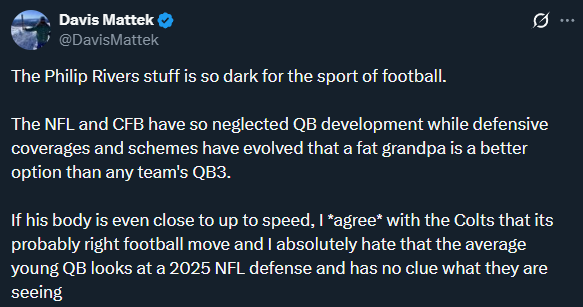
I argued with Davis about this at the time, because we like to argue, but also because he’s obviously wrong. The part of this that talks about neglecting QB development while defensive coverages is right, but it’s right because offense was so far ahead of defense for so long that they naturally kept simplifying things, and then defenses adjusted in exactly that way they needed to — to suddenly start caring about explosive passes more than being tough guys who stopped the run — and you had two ships passing in the night and now we’re at a point in this sport’s evolution where yeah, this specific thing is dark right now.
It’s going to be corrected quickly! That’s what the Rivers thing said. It said everyone is extremely clear that we need to start prioritizing the traits that the Colts were looking for in bringing Rivers out of retirement. You have to be able to process. If you can’t read and diagnose shifting and disguised coverages at a high level, you’re going to be lost. (The next step, obviously, without question, will be a shift back toward quarterbacks learning this with more emphasis at lower levels. That’s because we’re undoubtedly going to see defenses continue to evolve to where the split-field coverages and post-snap rotations are being taught at lower levels, too, because it’s a copycat sport. These are not things younger people are incapable of learning; we just haven’t been trying yet because the damn sport is evolving. The entire issue here is a narcissism of humans in general where we think the exact moment we’re in is special. It’s not. Or that the past is the only alternative. It’s not. Shit is fluidly changing. The future looks nothing like the past. We don’t want it to. But we’re also not entitled to anything. We can’t just let our whole damn society fall apart and act like there won’t be lasting harm. No, I’m not talking explicitly about football anymore.)
Davis’ comments about the average young QB being so lost are a very temporary problem that doesn’t even afflict everyone. But it does take time. It might be a few years before the inevitable changes at the lower levels I’m talking about lead us to another generation of pocket-passing QB prospects like the league had earlier in the 2000s. That doesn’t mean the sport will be ruined until then — we have a pretty damn good set of QBs in the NFL right now! The concern from Davis and I’d even extend this to Brady is always about young QBs who are struggling and how there’s a bleak future coming. And I just strongly do not see it that way. We have a good number of viable QBs in the middle of their careers, a bunch of young guys with a ton of potential, and we’ll have more decent ones trickling in over the coming years, even if their development is a little stunted by some of these macro factors.
I’m conflating two related but different issues a bit at this point, which are the mobile QB issue and then the lack of development. I believe they are pretty related because QB mobility leads to some of the simplified offensive concepts Brady and others have harped against. Heavy use of RPOs is a big target in these discussions, for example. RPOs don’t necessarily require QB mobility — see Tua Tagovailoa — but you do tend to see a correlation there, because of how the read option stuff can pair with the shotgun RPO game. They look similar.
But we moved away from shotgun, spread formations altogether in 2025. That’s the stuff I’m talking about — the NFL itself shifted aggressively toward shotgun, spread, three-WR, 11 personnel formations for years, and then just only started shifting back from that in the past couple years. At this exact moment in time, you can say it’s a horrible thing that none of these young NFL QBs knows how to run the under center game, but that’s because it didn’t seem relevant. It was an old way of doing things, just a few years ago. Now that it’s relevant again, lower levels will adopt it more. A ton of the elite high school and elite college systems are actually designed as NFL prep! Colleges recruit on that exact point, that they run systems that mirror the NFL and will get you a better look at being drafted because you’ll display those skills. There’s an incentive system in place that just hasn’t had time to catch up to how fast the NFL is moving.
Anyway, this tangent went on for far too long. To get back to the primary points of the shift occurring at the NFL level, in addition to the processing thing, accuracy has always been paramount at the QB position. I believe the disguises and the tough decisions QBs have to make have further emphasized that trait, as well.
Matthew Stafford hit Davante Adams on an out-breaker for a big conversion in the Rams’ overtime win over the Bears in the Divisional Round that got a lot of run for how impressive of a play it was on both sides (and rightfully so). Stafford had a great season and is one of these QBs who can process at a very high level, in part because he’s old enough that he came up in the era before the whole shotgun expansion that has led to the panic (but part of my point above is that if Stafford had come up 10 years later, he’d still be a very good NFL QB eventually, it’s not like he would suck just because he played in more simplified offenses at lower levels, because there’s a ton of talent there, although I do agree with the premise that it would stunt his early-career development and maybe he’d never wind up playing at an MVP level like he did in 2025 before his body gave out, in that different timeline; still, we’re talking about shades of different levels of play, not that the sport would be lost because without early development Stafford wouldn’t be able to pick up things at the NFL level and develop there in the same way he actually has in the real timeline).
But for a guy in Stafford who can read it out well, sometimes the decision will be a one-on-one throw where the leverage is right and the ball has to be released early — in the case of the throw to Adams, if the throw isn’t on time, the boundary quickly becomes the other defender that prevents a completion — and I’d argue with the post-snap rotations and those things, QBs are having to take these types of “good not great” opportunities and go win with elite accuracy more.
These types of plays have always existed in the sport, obviously. But the way I see it, there was a specific window where things got easier for QBs. For much of the NFL’s history, defensive backs could play really physically, and that meant tighter windows to throw into. Then the whole emphasis on defensive holding and illegal contact after 2014, which I’ve written about a ton, and how that ushered in an era of lighter WRs and WRs being allowed to run freer and all these things that right up until 2020 probably did give QBs more chances to hit pretty wide open WRs than at any other point in NFL history. And really, that’s what led to the defensive shift. That’s why Robert Saleh in The Playcallers said, “These offenses are too good. They’re just gonna look at you and they’re gonna — you wanna stay away from their uppercut. You know, I’ll take their jabs all day. But as soon as they start throwing those old school Mike Tyson — get in close and throw their haymakers at you, it’s over.” And as I wrote then, he spoke the quiet part out loud in terms of explaining the whole new foundational premise of modern defensive football being to start with a premise of limiting explosives and then work back toward the line of scrimmage, rather than the conventional wisdom through the history of the sport of starting with controlling the line and stopping the run and then figuring out how to also stop the pass.
So the league has shifted back, and probably we had this little bit in there where QBs actually were just getting some easier throws, and that was part of why the offenses were simplifying. Hell, to go back to the end of Tom Brady’s playing career, that’s probably part of why he was putting up career highs in counting stats at that point, including why he’d attempt over 700 passes in each of his final two seasons after a career high up to that point of 637. Hell, I can read it out, and you can stop my guys from getting wide open, so we’re just going to throw the ball every single time.
But we’re back to where, hey, you gotta be able to go make a big-boy throw, and then it is massive that you have the WR talent on the other end in Davante Adams to bring the ball in and toe tap and those things, and you gotta be able to execute when the margins get thinner. And I’d argue that type of accuracy is another trait that in large cohorts, you’re going to see more of with the pocket passers that have needed to rely on it from their high school days (and were good enough to ascend to the NFL), versus mobile QBs who definitely can have plus accuracy, but are more likely to be given real NFL opportunities for reasons other than that trait (see: Lance, Richardson). That’s another example of the two different factors at work that are nonetheless correlated.
What the past half decade has emphatically declared is you want a QB who has athleticism in addition, not an athlete playing QB. That may even be an issue for someone good enough to have a Super Bowl MVP on his mantle in Jalen Hurts, if we’re to believe that the Eagles’ struggle to find an offensive coordinator had something to do with their QB. I’m not sure where I stand on him — he’s a tough one — but for what it’s worth I’ve seen enough from Lamar Jackson and Jayden Daniels, who were the top two QB rushers in 2024 before both dealing with significant injury issues in 2025, to believe those are the kinds of guys who are QBs who have athleticism in addition. If those guys are healthy and playing well, I think they will be fine even as the NFL evolves, and for fantasy they may be able to gap a lot of other QBs who don’t have both traits. They may be 700-yard rushers in 2026, and that may provide a bigger bump over the competition if there are fewer Fields types who can run despite not great passing numbers.
Your mileage is going to vary on the individual players a little bit, but the point to emphasize remains that if you can’t read and process defenses, it’s going to be disqualifying, no matter how much dual-threat capability you bring to the table.
To wrap up, I have to circle back to some of the results of 2025, because I only really used Rivers and to a small extent guys like Flacco and Stafford to make the point. But I also want to mention slightly more mobile guys who are nonetheless pocket passers, like Sam Darnold and Baker Mayfield, and their comebacks (Mayfield’s was more about 2024 than 2025). And then the guy I have not mentioned but need to is Jacoby Brissett, if only because the Kyler vs. Brissett outcome was probably the best direct comparison we got in 2025 where two very different styles of quarterbacks played in the same offense. Kyler obviously got hurt, but the way Brissett played made it pretty undeniable he was the better option even after Kyler seemed healthy. Arizona was sort of forced to admit the pocket passer chucking it 40 times made the offense work at a higher level, even though failing with Kyler was likely to (and did) cost the coaching staff their jobs. You just didn’t have any other option; you were going to lose the locker room and be a midseason firing if you didn’t roll with Brissett.
But there are other important things going on. It’s not easy for pocket passers in the current NFL. And the development stuff Brady (and Davis) talked about is valid for the moment. As we move forward in fantasy football, I want to be extremely cognizant of the expected quarterback play within offenses, particularly as it relates to type. Brissett is the best example of this from last year, but he also reinforces the uncertainty we’re dealing with, because the Trey McBride league-winning season was undeniably boosted by a switch from a QB we’d typically want to avoid (Kyler) to his backup. We got a similar outcome a couple years ago when Richardson went down and Gardner Minshew changed the whole offense and turned Michael Pittman into a 156-target WR.
That does mean, yes, that strength of backup QBs is important to consider, but you have to properly weigh contingent scenarios that won’t always hit. Right now, we’re just understanding the trends, and what is happening with the league, so we have the foundations in place to make good decisions on a case-by-case basis.
What we know is there is absolutely a lull in processing ability around the league right now, and yet we’re moving more toward an emphasis on how important that trait is than ever. And yet, as a tease to the other stuff coming in this series, it won’t just be about the QB. As I talked about with the Stafford example with the margins thinning, another thing we learned in 2025 is coaching and scheme matters maybe more than I can ever remember. Sam Darnold wasn’t a good processor until he got into what I’d argue were two very good situations, with two different teams, two years in a row. In fact, I’ll make the case in the next post that Darnold’s situation this year was one of the most favorable for a QB to find success in since I’ve been watching the sport, which isn’t to minimize his accomplishment, but is meant to emphasize that coaching was able to elevate in 2025 in a way I don’t know if we’ve ever seen, and in a year like that, he had Mike Macdonald and Klint Kubiak as the absolute peak of the discussion for elevating the talent on their roster for this elevated season. Thus, I’d argue Darnold was elevated more than anyone over the course of multiple years.
But we’ll talk more about the specifics of that claim next time. This is where I need to stop for today. Progress. We’re getting some of these takes out. I’m kind of on a roll so I’ll definitely try to write again tomorrow. Until next time!
Thanks Ben. There’s one step in this evolution that I could use some clarity on. I get 11 personnel spread dominance led to defensive adjustments toward lighter / faster personnel which allowed mobile QBs to capitalize on the ground. But as defenses continue to play light, these same QBs are being played off the field or just not rushing as much. Is the logic here that defenses have continued to evolve to the point where they can expose QB processing AND limit their rushing? I understand the Fields’ of the world get played off the field but it feels like there’s more at play even with the mobile QBs who are +’s in processing.
I didn't really watch much of the Arthur Smith/Rodgers offense in PIT this year for my own sanity, but I'd argue the biggest drop off we saw in Aaron's game in the last few years was he couldn't handle post snap processing. He was one of the best in the league for years in manipulating a defense presnap and couldn't change with the meta. The play he tore his achilles on was directly caused by this.