

3 (more) ways 2025 was a transformative NFL season
And how it will have a significant impact on fantasy

Well, we’ve been working through this post in batches, and I can’t promise this will be some revolutionary main event. I’ve already covered most of the deeper ideas, and the few trends I’ve saved for today are interesting but lower-impact in their scope.
I started all of this with the positional trends pieces that laid the groundwork a couple weeks ago. Last Thursday, when sitting down to write this post, I branched off an introduction. Then on Friday I dug into the ways things are shifting at QB, specifically with respect to key traits of processing and mobility, and then on Sunday I wrote another treatise on coaching age and scheme, which included several hundred more words following up on the QB stuff.
As I’ve talked about through these posts, there is an interrelatedness to all of this. “The old world is dying, and the new world struggles to be born.” How I’m describing these changes isn’t always perfect, but the trends I’m writing about are not spinning stats to tell some story that doesn’t fit with the actual games; I feel strongly 2025 was a pretty unique season, though as I’ve said, I think some of what has sped up evolution and innovation may just be the new normal, given the trends in coaching hires.
Right after I hit publish on that coaching piece, the Cardinals announced Mike LaFleur, brother of Matt, as another under-40 head coach as he takes over in Arizona at the age of 38. The list of recently-hired under-40 coordinators got longer, as well, with the Browns tabbing 33-year-old Travis Switzer as their new offensive coordinator, and the Dolphins adding guys on both sides of the ball, giving 38-year-old Bobby Slowik his second chance coordinating and hiring one of the youngest new coordinators of the cycle in 32-year-old Sean Duggan to support new head coach Jeff Hafley in leading the defense. In some cases, we saw a balance of the young coaches hired by older head coaches, or younger head coaches hiring older coordinators, but Hafley is a 46-year-old first-time head coach who went young on both sides of the ball, and that’ll be one of the lowest collective ages for those three roles in the league (and probably ever).
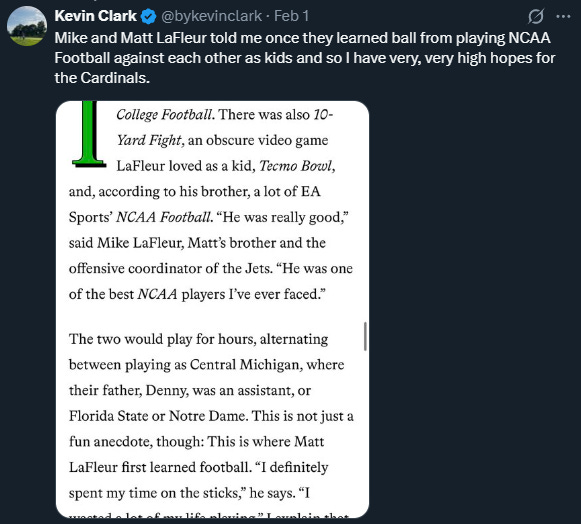
I may have missed some others, honestly, but that was four more under-40 hires in addition to the two head coaches and 10 coordinators I wrote about in the last post. One of the things I saw on Sunday and loved was Kevin Clark detailing how the LaFleurs learned ball playing NCAA Football against each other, which was a huge part of how I learned the sport, too. This obviously gets at the notes I shared in the last post from Frank DuPont’s book, Game Plan, about repetition and experience, and how the increased realism of simulation video games allowed for a rapid informational advantage in the modern era.
As we wrap up these posts, I do still have one last introductory note, which is just to step back for a second and say that one of the things that happens with these posts is I do get pretty excited, and sometimes ahead of myself. As I often say, I’m no expert. I’m just a guy who watches a lot of football and is maybe, I don’t know, good at noticing patterns, and endlessly curious about the “why” of stuff. But I also mostly believe in the idea that when you’re an expert on something, you should be able to explain it in fewer words than I’m explaining stuff in.
I’m always working through a bunch of threads in my unstructured brain, and I’m mostly just grateful there are enough of you who subscribe here and want to read what I have to say, even when it’s not processed particularly well. But I’m very aware of my own inability to better distill points, and a number of issues it creates. I just want to say thanks to those of you who read and appreciate the content despite all that, even if I never hear from you. My work could be better, but I do always feel fortunate to not have a laborious editing process, and I’m OK with the work as it is, so long as I have readers and subscribers that are, too.
But it’s also important, especially when we get into dense topics like this, that I make clear that some of the little details might not be perfect, and I’m aware of that. I’m sharing because I do strongly believe there’s a directional accuracy in the broader discussion, and it will hopefully provide a common understanding from which we can talk deeper about related concepts.
Let’s get into the other three things I’d wanted to discuss.
Receiving, explosives are the keys at RB
One of the trends we’ve seen over the past several years is a decline in RB receiving, which made 2025 a particularly enjoyable year on that front. From a real football standpoint, what we found this year was RB receiving is one of the leaks with the modern schemes where you can get a RB out of the backfield into a great matchup.
Back in the day, as tight ends got more athletic, the discussion was always about getting a guy like Jimmy Graham on a linebacker or safety as a mismatch. There are still mismatches to be had for TEs, but it seems those are addressed a bit more, and the ways defenses have evolved have really started to create opportunities for RBs out in a route. The way I think of this is there are five eligible receivers, and the TE is often like the third or fourth in a priority list, and maybe old coverage schemes couldn’t quite answer all three or four things, but newer ones are doing a better job of it, so offenses are pivoting to that fifth priority which is the RB on a slower-developing route further off the ball. That makes it more difficult to pull off, but we saw a clear trend with RB air yards in 2025.
What makes it easier is when the player is dynamic. When explosives are at a premium, explosive RBs are necessary. We’ve been taught for years that RBs don’t matter, but as defenses take more and more away — and RB is the position they increasingly ignore — it’s extremely beneficial to have a plus athlete with big receiving potential in the backfield. When you do run the ball, you’re basically running to find explosives. You can’t use Kareem Hunt and celebrate his success rate. It buries an offense.
We only get 32 teams to study, and one big data point here is the Patriots. Interestingly, Rhamondre Stevenson was in that same boat as Hunt, and TreVeyon Henderson had really started to take over touches, if not necessarily snaps because, yes, Stevenson was doing all the little things. Teams do like guys who are high-floor, do-no-harm types, and Rhamondre was a far superior pass blocker to TreVeyon this year, and it’s why he always maintained a bigger snap share. But what I think a lot of people missed is the reason Henderson ultimately got buried was Stevenson completely turned his season around.
Here’s a crazy stat, but before I share it, I have to say I’m going to cite single-game yards per carry. That’s going to make some people recoil, but I wrote in one of the intros about how explosives have an outsized impact on these types of rates. What consistently poor weekly YPCs tell me is the player is just not creating explosives, full stop.
In Rhamondre’s first 10 games, he averaged 3.2 yards per carry and never went over 5.0 in a single game. In his next five, he averaged 8.5 and went over 5.0 in every game. It wasn’t until he got a lot more work in snowy games against Houston and especially Denver in the postseason that he started to lose some of that rushing efficiency again.
The response from New England makes some sense if the guy they preferred on pass blocking and those things was suddenly also creating big plays. And that’s where they’ve gone with it. But there was a long stretch there after Henderson made some big plays where Henderson out-touched Stevenson for several weeks, until right around when he got concussed, and Stevenson had started playing well, and Henderson hasn’t gotten back into things. It’s sort of semantics, but my point is essentially this has flipped multiple times and most people missed that nuance. Anyway, Stevenson’s weird season and Henderson’s potential to just not be great are individual data points in a larger trend about explosive backs, and I don’t want the whole discussion to hinge on them.
Last year, I talked about the rise of the TRAP back, and how it was tied to the explosive plays for Saquon Barkley. Barkley hit fewer this year, and it was pretty rough. Jonathan Taylor took over that mantle during the good times for the Colts, but things got a lot worse down the stretch for them. The Seahawks’ offense has opened up with Kenneth Walker in the postseason after Zach Charbonnet got hurt. You just can’t have guys like Charbonnet, Brian Robinson, etc. as the answer. This explains my Woody Marks opinion, for what it’s worth. There are too many people who think you don’t need talent at the RB position. While you can see stuff like what’s happened with Stevenson and argue that can happen to anyone, I’d argue Stevenson is a guy who has shown that polarization over his career, with significant ups and downs already. I don’t believe he’s the norm. It’s not as interchangeable as people want it to be.
And the explosiveness, and the ability to eat up space, is just so big for offenses. We saw it more from Bijan Robinson, and he was about the only thing Atlanta had going for it at times. Yes, Atlanta’s offense wasn’t very good, but it was better than, say, the Jets, where Breece Hall was not finding the same space. And I’m not saying that RBs control this entirely on their own, or those kinds of things. One of the really fun things with Bijan last year was how the Falcons started to show a Christian McCaffrey skillset, lining him up out wide and having him run routes at coverage guys.
I haven’t shared any receiving data, but we had just two backs over 65 catches in 2024, and then had six of them in 2025. Last year, we had zero backs over 600 receiving yards; this year, three. Both Bijan and CMC were over 800, and then Jahmyr Gibbs was the third at 616.
(I know with some data, it can feel like the jump from two backs over 65 catches to six doesn’t feel that large. But six teams would represent 19% of the league’s 32 teams. If I say about 6% of the league’s teams had a 65-catch back in 2024, and then that was up around 20% in 2025, does that drive it home better?)
It’s easy to look at these up-and-down trends from a fantasy football lens, but I’m more interested in it from a real football perspective that then impacts fantasy. Offenses need explosives, and a huge counterpunch this year was the ones who have elite athletes in the backfield utilizing them as receiving weapons, including down the field, in a way that is clearly on the upswing. If it sticks, it will in turn become extremely notable for fantasy.