

Field Tippers — 2026, NFC
Finishing up our contextualizing of the league's per-route profiles

I wanted to get this piece out by the end of February, and got through half the teams by then, but I’ve been dealing with a nagging sickness and had to prioritize some other stuff in the past week or so, delaying me a bit.
The trip I mentioned at the end of the last post was great — I took the family down to Arizona for a few days to visit my brother and family, which was a really nice reprieve from the Seattle weather even if we ran into one of the colder stretches of the year in Arizona. I got to play some backyard football and other fun games with my three nephews and my daughters, see some extended family that was also down there, and also go to my first ever Mariners Spring Training game, so the trip was a pretty huge win. My daughters and nephews got Logan Gilbert’s autograph, among other Mariners, so that was a huge highlight.
But I got sick on the trip and it hit me right after I got back, and I’m only just feeling closer to 100% in the past few days. I’m starting out with this note because the timing of this post is very relevant. I wanted to get it out frankly before the combine and the leadup to free agency, where we’ve started to get the tag and cut information. Among other things, the DJ Moore trade likely biases my view of DJ Moore’s 2025, in that I want to be excited for him in Buffalo. When I finally wrote the Chicago section below, it was harder to discuss how poor his season was with clear eyes.
The whole point of this post is to review 2025 without those types of biases. The key is there is crucial context I want to layer in from my work during the season, while that is most fresh, without too much time and noise getting in the way. I believe pretty strongly that there is a lot of that in fantasy football circles, and it’s a major edge. We’re always dealing with small-sample datasets, and things like player health or measures of team health — like how actively teams are pushing to win at various points of the season — aren’t equivalent across all 32 locker rooms, throughout a football season. These things inevitably impact the data we have, and I’d argue more significantly than we ever really understand in the offseason, though we do a better job of understanding the ambiguity during the year.
But after months of an offseason, that nuance can be lost, and the raw results settle like concrete. We look back at data as if there were no other ways things could have gone. In a fantasy landscape in 2026 where the advanced data is ubiquitous and has a profound impact on draft prices, there’s a huge edge in understanding where to apply caveats to past results.
And as always, a huge part of my edge as an analyst is how much energy I put into the in-season research. That’s not just about some measure of hard work, because if you don’t understand what you’re doing, it really doesn’t matter. Ultimately, what matters is actually being right. But as far as what I do, research-wise, it’s at least fair to say that most people opining on this stuff are not doing the two-step I am which is watching every single game individually every week, and then analyzing and writing about the data from every game, every week. I document that so you can follow along, and understand exactly what my priors are, and how they are changing. It’s easy to simplify things to a single perspective like “Draft Player X” or “Sell Player Y,” but a lot harder to show your work.
I’m trying to thread a needle here of not acting like that makes me better than anyone, but also noting I gather a lot of information through that process, and it allows me to have a strong understanding of the storylines created by the weekly nature of the sport. As I just argued, I find it extremely necessary to understand the trajectory of teams and the shape of player careers to make accurate predictions going forward. We can’t let that stuff get lost in the wash.
So I’m a little annoyed at myself that it’s taken me into March to get through this crucial work. At the same time, the reason this work got pushed into March is not that I wasn’t doing anything along these lines. I recognized this is a unique offseason from a macro perspective, and I needed to rise to that challenge as an analyst, as well. I wrote seven macro-level posts between the beginning of January and early February, totaling over 30,000 words (not that I’m efficient with my words, but among my bloviating is a lot of analysis) about the direction of the sport and its impact on fantasy football. If you missed those, here are some links.
In many ways, the deep dives are better left for the later part of the offseason, in the summer when interest starts picking up again in advance of the next season. But I love writing this time of year, not as an actual content creator or human, but because of what it means for my analysis. I’m proud of the work I’ve put out so far, and feel strongly that it was time well spent.
And yet, as I just alluded to, I’m both not an efficient writer generally, and also definitely not this time of year, on the back of a long season when I should be taking some time to chill. So it’s been a little rocky at times, and the analyses this year seemed to get longer and longer, as today’s breakdowns will attest. I could’ve tried to edit them down, and hell I’m sure AI would be useful for that, but I guess I think it makes more sense to be delicate with the details in a 2026 landscape where the raw data is more ubiquitous, and the caveats more interesting, than when I was doing this type of analysis in, say, 2021. (Adding to that feeling is how back in 2021, I was just jotting down some preliminary stuff, but in 2026 there is already a real market out there with a ton of drafts happening and you feel more pressure to come prepared with a pretty full analysis.)
So there’s a lot here, but I wanted to emphasize what I see as the scope and importance of the work, even if parts of it don’t feel as related to the current moment. What I should be writing to you about today is a bunch of fun trades and free agency notes! But that’s not what this post is, as I wrap up the pre-free agency period of my work.
What’s cool is this stuff usually winds up being some of my most accurate work all offseason, and it’s a big part of why I went into everything I just did in this intro. I continue to push myself to be this detailed right at the close of the season, and maximize the carryover of my understanding of the 2025 season, because I’m quite sure that’s what has driven that accuracy. I want to document this stuff, if nothing else, so I can refer back to it.
But even just here in early March, a month after the Super Bowl, I already fear losing key details. We finish up with the NFC today. I wrote a huge intro in Part 1 from a couple weeks ago that explains the details about what we’re doing here. The data you’ll see is presented in this format:
Player Name - TPRR, wTPRR (total routes)
Because total routes are key data, I present only regular season data here, so I can keep all 32 teams on the same games-played sample. It’s important to this analysis to parse whether production came largely from route volume due to significant team-level dropbacks, or was more about per-route production. Even as I type that, I’m thinking about important caveats like how difficult it is to have elite per-route numbers at super high volume — teams that drop back in huge numbers tend to be in shotgun, WR-heavy formations where the ball gets spread around more in those spots, leading to more spread TPRRs, versus teams that tend to limit passes and where a higher degree of player routes are run in situational spots like play-action or RPOs where it’s easier for No. 1s to concentrate volume, for instance. There are a number of these things that play into how I believe TPRR should be accurately used, and I always dig in because of how TPRR is criticized by many, but I’m not going to restate all those ways here. Read the intro to Part 1 if you want more. You’ll also find all the AFC analyses there.
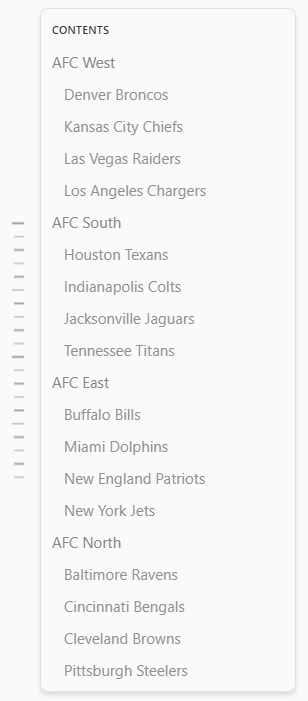
As a reminder, if you read this at bengretch.substack.com, there’s a table of contents on the left side of the screen, if you click the bars on the left of the below image (the contents list will expand and look like this, which allows you to easily click through different teams):
While 2025 was a wild season in a variety of ways, including a lot of offenses doing different things that made the type of analysis I do here a little trickier, I did find that for whatever reason there were cleaner TPRR-based analyses for more of the NFC teams, which I’m excited to get into today. I wrote a bunch of this hopped up on cough medicine and exhaustion, so apologies that some of these writeups are at times excessively detailed. There are a few players where I got away from myself and wrote like an entire player profile for the 2026 season, it’s kind of hilarious.
Let’s get started.
NFC West
Arizona Cardinals
Trey McBride - 0.23, 0.53 (695)
Bam Knight - 0.22, 0.38 (132)
Michael Wilson - 0.20, 0.53 (631)
Marvin Harrison Jr. - 0.19, 0.53 (384)
Michael Carter - 0.18, 0.32 (237)
Emari Demercado - 0.16, 0.27 (116)
Greg Dortch - 0.15, 0.28 (215)
Elijah Higgins - 0.12, 0.24 (300)
Zay Jones - 0.09, 0.26 (173)
Xavier Weaver - 0.06, 0.18 (198)
We start with a good use case for a point I frequently make about past data and ranges of outcomes. One of the ways I talk about this is after the fact we like to act like results were the 50th percentile outcome, or the only thing that could have happened, when that’s pretty obviously not the case and there’s considerable value in understanding when players did hit meaningfully above or below that 50th percentile (because of the weight put on that outcome). That can be viewed a variety of ways, but in this context I’m talking about team passing environment, and I’m particularly focusing it relative to expectations. In 2024, Arizona was 21st in pass attempts, and the expectation coming into 2025 was Kyler Murray would be the primary QB again and his mobile tendencies would likely keep things in a similar range. One key about Arizona’s 2025 is it played out in a way where it’s not necessarily weird they moved on from Murray, but how quickly that happened — Murray made just five starts before Arizona was done with him for the year, citing some injury stuff but pretty clearly just moving on. Jacoby Brissett ushered in a new offense that was extremely pass-catcher friendly with a huge rate of dropbacks and pass attempts, and Arizona actually led the NFL with 649 pass attempts, a gain of more than 100 over 2024. They also led with 427 completions. (As far as a hindsight thought of how we can better account for this type of outcome, I’d note that in the past I’ve weighted backup QBs as a relevant data point, but the way I’d put this is any process that put really any weight on Arizona leading the NFL in pass attempts and completions as a possible outcome is a process that by necessity would have to put weight on a massive variety of low-probability outcomes that wouldn’t necessarily hit, such that it would essentially be extremely imprecise and probably not of much use. Some will see that as skirting accountability, but my argument for a framework that allows room for outcomes like this is actually that point about the NFL being chaos, and how uncertainty rules. The point isn’t how we could’ve predicted Arizona’s pass environment in advance, but how we can keep an open mind going forward to very low-probability outcomes that seem outlandish, even as we try to dial in most likely scenarios when we do things like projections.)
How this manifested on the player level is extremely interesting, as well. We’ll start with Trey McBride, and for him two things can be true. First, he is an absolute superstar in a variety of ways that frankly everyone should love which I’ve been telling you about in the weekly column since at least his first meaningful full-time action in late 2023, because he was one of those guys where in addition to a fun prospect profile, it was just very clear right away when you watched the guy in the NFL he was the real deal. I’ve called him my favorite player in the league on multiple occasions. I’m not boasting; I’m setting a baseline for the other shoe I’m about to drop where my bias is extremely pro-McBride. Second, his 2025 seasonal outcome was well above the 50th percentile, and is probably one of the very best situations for a TE — especially relative to expectations entering the season — that we’ve ever seen. Did he elevate that because he’s great? Absolutely. But let’s just start with his routes. In 2025, McBride ran 695 regular-season routes, which were more than 100 clear of all other TEs this year, and also all of 2024. I actually clicked back through 2006, which is all the seasons PFF has routes data for, and the closest TE routes season in 20 years was Jason Witten running 628 in 2012. Let that sink in; McBride just ran 67 more routes than any other TE in a season in at least 20 years. That’s more than a 10% bump over the previous highest season in that span! It’s more like a 25% bump over what we’d consider other high-volume routes seasons for TEs. I mean, he basically ran like four games’ worth of additional routes over other high-volume TEs. (Given the 17-game schedule and evolution of the position where it wasn’t as much of a feature before 2006, it’s highly likely McBride just ran more routes than any TE in a season ever, and not just by a small margin.) Anyway, this alone is one of the craziest stats of the season, but there’s more. While the Cardinals were first in attempts and completions, they were only seventh in passing yardage, because the offense featured a huge volume of dropbacks in trail scripts against drop coverage with underneath throws. That played favorably for McBride in particular. And then there are touchdowns. McBride went from a 2024 season where Murray basically couldn’t get him the ball in the red zone into a first five games of 2025 where he had just one score, while working with Murray again. It seemed like it would again be an issue. Then Brissett took over, and suddenly McBride didn’t just start scoring a little bit more, but he immediately became on of the most prolific touchdown threats in the league, regardless of position, scoring 10 times in the final 12 games. Interestingly, a bump in TD rate was actually something I did project last year — I remember talking about it with my buddy Michael Leone in our projections pods last summer, where I was quite bullish in projecting a TD rate well above any of his past data, and I bring that up to say a few things including probably that I’m proud of that analysis where I prioritized a bit of the art more than the science in a spot I felt strongly about the skill of the player (and was right, because obviously you can be wrong doing this, too), but also that even when I did take that bullish line, a) I only projected him for 6.8 touchdowns, even though that was only 0.5 shy of my highest TE projection (Kittle) it was well short of the 11 he actually finished with, and b) it didn’t make McBride my TE1, indicating that you were going to really have to deviate from some baseline stuff to get McBride there if I was already quite bullish and still didn’t. Interestingly, it was Brock Bowers who ran the most TE routes in 2024 (592), and where the question in 2025 projections was how to respond to that. Bowers’ 2025 season reflects a lot of what the concern for 2026 might be for McBride, which includes getting dinged up and missing time, but also a different team environment; among the scuttlebutt early this offseason is the possibility Malik Willis could land in the desert, and Willis has never thrown more than a very-low 23 passes in a game (he only has six career starts; the Willis discourse about him getting $30 million per year is fascinating, but wherever that dude lands we’re going to be talking about dropbacks and pass volume as major concerns). Now, none of this means you fade McBride, just like similar concerns didn’t mean you should fade Bowers going into 2025. But again, Bowers ran more than 100 fewer routes, and this was still a concern for Bowers coming off that 2024; it’s really difficult to maintain this level of route volume. One major point in McBride’s favor is part of the reason the route volume was so high is he was clearly the focal point of the offense, and when we just look at the per-route data, running that many routes diluted things, which leaves per-route meat on the bone even as routes dip. In both 2023 and 2024, McBride had identical TPRRs of 25.9%, but that fell to 23.5% even with the high rate of underneath throws. I mean, he had 169 targets, 51 more than any other TE, and his TPRR still fell nearly 2.5 points from his past two years because of all that route volume, and the inevitability of empty routes in there. His YPT also dipped a touch, but not massively, and the net result was a 1.78 YPRR that was still very good for a TE but for him was down from the 2.03 and 2.14 figures he posted in 2023 and 2024. These per-route dips aren’t concerns; they are reflections of the environment I just described, and the pure routes volume I emphasized first. Bottom line about McBride going forward is the setup in 2025 was about as perfect as it gets, and also that he posted the kind of season you’d expect from a truly elite TE in that kind of setup. He’s a phenom. He’s also very likely to see a substantial reduction in routes in 2026, and it’s possible that reduction is pretty massive if the QB situation trends back toward someone with mobility. I’m rooting for Brissett to get a lot of playing time again in 2026, and he’s still under contract so that’s nice. But it’s a new regime, and they are going to have some other QB to get reps for and presumably develop. And even if/when Brissett plays, we can’t expect the dropbacks to be the same under a different coaching staff. That’s a key point, as well — even controlling for Brissett, the 2025 pass environment was a massive outlier. So anyway, like I said, two things are true for McBride. He’s exceptional, something his record-breaking raw numbers tell you. And he also had a near-perfect situation, even if his own ability helped drive the circumstances of that environment in a way we could reasonably expect to exist in future seasons of his career — because any coaching staff would be crazy to not utilize this guy at a high rate — and there’s really no way to handwave the extent to which 2025 was an outlier from a situational standpoint. (Fortunately, even if we maybe just saw a career season production-wise from McBride, early drafts don’t require you to pay prime Kelce prices, as McBride is going in Round 2 on Underdog with an ADP of 16.0, which is only about a 10-slot bump from his 2025 ADP in early Round 3.)
OK, I just wrote a 1,300-word paragraph about McBride, which is not me getting off to a good start in my goal to work through the NFC side of this post efficiently. (He’s also my current favorite player and had one of the most interesting seasons in recent memory, so sue me.)
There’s probably more buyer beware with Michael Wilson than McBride, when it comes to all the above about routes volume. Wilson’s 19.7% TPRR was a big bump from a previous career high of 14.2%, but was clearly and obviously impacted by Marvin Harrison missing time. I don’t think Wilson is going back to a purely ancillary role, but he ran a career-high 631 routes — one shy of Ja’Marr Chase’s league lead at the WR position of 632 — and Wilson’s 1.59 YPRR isn’t some massive breakout year. Obviously, I do have to caveat the 19.7% TPRR and 1.59 YPRR with the same notes about how routes volume make things difficult, and the TPRR is particularly impressive at his 12.2-yard aDOT given my notes about the team dropping back against obvious pass defenses while in trail script at a high rate over the course of the season, plus the splits data where for example Wilson had 18 total targets across the first five games where Murray was the primary QB, but had an 18-target game later in the season when Brissett was under center and MHJ was out (as well as two more games with at least 15 targets, and two more beyond that with at least 10). But as more of a film take I do want to document, all that concentrated target volume did include some quick throws in shorter areas, and a reality Brissett really seemed to key on the two guys, McBride and Wilson, in a way you just don’t see from most QBs or in most offenses. The extent of it was truly pretty crazy, and Wilson would frequently run quick outs and those things, which Brissett would really seem to fire at a high rate (some QBs do just like throwing to certain guys, and when you watched these games and tracked them on a weekly basis, it was hard to deny Brissett and Wilson had a thing, maybe to a degree stronger than any random, lower-profile QB-WR connection I can remember in a long time; it was like Flacco-Njoku on steroids). My conclusion here is it was a great environment for Wilson in 2025, and it’s very likely 2026 will feature some combination if not all of the following: fewer routes, more target competition from other WRs, and a weaker connection with his QB. He’s not super expensive in early drafts, but he still probably wouldn’t be a big target for me at an ADP around 75 overall.
That leaves Marvin Harrison as the other key name here. MHJ ran just 384 routes, and his TPRR fell from 21.0% as a rookie to 18.8% in Year 2. His YPT was a bit better so his YPRR was pretty static, falling from a disappointing 1.63 as a rookie down to 1.58 in Year 2. An important bit of context is how that was right in line with Wilson’s YPRR in 2025, though again Wilson had some extreme splits. But it’s relevant that Harrison is as high profile as he is, and that Wilson would only get featured to the maximum degree when Harrison was out. Their ADPs are very similar in the early going, but I’d still bank on a longer view thing here with Harrison, whose collegiate track record was strong, with two great years, in addition to the high draft capital. He may not ever be a superstar, but I’m not ready to buy him as a complete bust, either. It’s just a really weird situation through two years that’s difficult to explain, with the best explanation being he’s likely not the degree of player we thought — and maybe some degree of his collegiate production was propped up by an offensive focus driven by name value, as he had these massive TPRRs and wTPRRs that drove his strong YPRRs (and overall production) more than depth-adjusted after-the-target efficiency — but that he’ll still be a better NFL player than what he’s shown through two years. Relevant context between him and Wilson is that Wilson just turned 26 this month, while Harrison turns 24 during the preseason in August, and is obviously still a young guy who dealt with an injury-plagued second season.
That’s a ton of words on Arizona’s three main players, but there isn’t really anyone else relevant. The next three highest players in TPRR in the above list are all replacement-level RBs, and benefitted from the script-aided underneath passing. The fluctuations in their individual profiles at lower routes samples are mild, and indicate this was a systemic result. Greg Dortch had a really low aDOT and a weaker wTPRR than his already pretty unimpressive TPRR. Zay Jones and Xavier Weaver combined for 371 wind sprints.
Los Angeles Rams
Puka Nacua - 0.35, 0.84 (462)
Davante Adams - 0.27, 0.76 (410)
Colby Parkinson - 0.23, 0.49 (245)
Tyler Higbee - 0.19, 0.40 (189)
Davis Allen - 0.17, 0.35 (194)
Terrance Ferguson - 0.15, 0.47 (168)
Xavier Smith - 0.15, 0.45 (148)
Kyren Williams - 0.13, 0.24 (350)
Blake Corum - 0.12, 0.22 (116)
Konata Mumpfield - 0.12, 0.33 (177)
Jordan Whittington - 0.11, 0.24 (215)
Tutu Atwell - 0.10, 0.35 (143)
For a team with a notoriously concentrated target tree, this is a long list of players who ran at least 100 routes, and that gets at the subpackages Sean McVay deployed more of in 2025 (and I’ve written could be a feature of more offenses in 2026 and beyond as the league evolves). That’s instructive as to why we see no one over 500 routes here, though it’s worth noting Puka Nacua missed Week 7 and was limited both before (51% snap share in Week 6) and after (49% and 52% in his two games after returning) the game he missed, while Davante Adams played just 14 games. In actuality, both of these main two cogs likely would’ve run over 500 routes in a healthy season, which is a solid amount, and the rotational stuff probably should be thought of starting behind these guys on the target totem pole, as far as who the No. 3 and No. 4 weapons are, because there was not another non-RB who ran more than 250 routes.
For Puka Nacua, we get a 3.71 YPRR season off his even more shortened 2024 where he was at a 3.56 number that seemed unsustainable over a larger span. Some of that was because of some routes limitation at times in the regular season; he went into the postseason playing a lot more, and in three postseason games he totaled 42 targets, 24 catches, and 332 yards (i.e. 14-8-111 per game) and that was “only” worth a 2.96 YPRR. The way to think about Puka is that yes his 34.6% TPRR is insane and probably would be unsustainable if there weren’t some situational stuff here, but that’s not relevant because his body of work over three years now is so insane in this offense that he’s gotta be the choice for WR1 in 2026. I have concerns about the health and the perception the Rams took it light with him for stretches in 2025 more than anything else, but I mean we’re basically talking about the Christian McCaffrey profile here where if he stays healthy he can do things that are almost unreachable by other players. (I’ll add additional concern about the health of his QB, whose back injury was so bad last August it wasn’t even clear if he would play before his MVP season.)
As far as WRs, though, I’m way more concerned about Davante Adams, who had a strong year but missed the three games and saw his YPT dip to 7.1, his third straight lower-efficiency season, even as his aDOT rose to 13.6. In terms of depth-adjusted efficiency, he was pretty poor, and stuff like his YAC per reception cratered, as he clearly showed his age. Adams’ deal seems to tie him to the Rams for next season, which is ideal for his fantasy value because of the touchdown element. He’ll be 33 for most of the season, turning 34 in December, and we’ve seen an age-related decline. From 2020-2023, Adams posted four straight 100-catch seasons with at least 1,144 yards (and he posted at least 1,374 in three straight from 2020-2022, so the 1,144 was maybe the start of a decline). In his 2024 season split between the Raiders and the Jets, Adams still managed 1,063 yards on 85 catches across 14 games. In 2025, also in 14 games, he was down to 789 yards on 60 catches. He then played three playoff games where his yards per game were up about 5 over the regular season, but he caught just 11 of 25 targets, and scored once in three games after averaging a TD per game in the regular season. My read would be Adams’ red zone prowess and the 14 TDs masked not only age-related decline as that relates to fantasy production, but how some elements of his 2025 weren’t such a hit for the Rams, including his deep production. It doesn’t mean he doesn’t have value to them, but it ratchets up the possibility they go away from him a bit next year as their offense continues to evolve. I think he’ll still have a role to them, but as the Rams showed these subpackages and rotational elements in 2025, I’d be pretty shocked if Adams didn’t get caught up in that a bit in 2026. He had over 1,500 air yards in 2025, which for example is the kind of thing I’d be pretty shocked to see again. We just saw Sean McVay do similar in phasing out Cooper Kupp over his latter stages with the team. Adams’ early ADP is in my mind extremely lofty in the middle of the fourth round for a guy who is basically dependent on all the TDs, and where I can visualize a ton of “big miss” scenarios, including probably a high expectation he won’t play all 17 games at this age when the team is clearly going to be fixated on a title (they are co-favorites or second favorites in the futures market, currently). Anyway, the discussion on Adams will likely continue all offseason as people harp on the value of TDs, but I’m not sure more really needs to be said about him until the season starts. We won’t know until 2026 plays out whether his TD potential offsets the clear age-related risks for a second straight year. I can’t really make an argument against his TD production from 2025 other than it seems unwise to bet on a TD per game again in 2026, at his age, regardless of his track record in that area. That’s basically the whole discussion, but for me, if his cost stays remotely this high, I can’t imagine drafting him much at all.
I really don’t know what to make about the rotations behind these guys. At RB, Kyren Williams was wildly more efficient after the target than Blake Corum, with the second-year player who had a breakout rushing season posting a putrid 2.6 YPT and 0.31 YPRR that doesn’t argue he deserves more routes. Kyren’s big routes lead is certainly something in his favor.
For the TEs, Colby Parkinson posted the most routes and easily the best TPRR at 23.3%, with a solid 1.67 YPRR. Tyler Higbee wasn’t far off after his return, though, and then you just have all these different roles, with Davis Allen also somewhat similar in TPRR but at a lower aDOT, and then rookie Terrance Ferguson having a lower TPRR but a ridiculously high 18.3-yard aDOT as he was sort of a situational deep threat later in the year, and he made some plays to the tune of a 9.2 YPT. I think Ferguson’s probably the most interesting bet entering his age-23 season, as we know young TEs can take a bit and I find it promising he got some specific situational usage right away as a rookie. But I probably also expect there to still be split routes and target volume from the heavier 13 personnel packages that isn’t great for fantasy upside, among the Rams’ TEs. Ferguson’s an intriguing late-round guy, is what I’m saying, but if he steams up at all this offseason that’s tricky. I’ll also keep an eye out for other WRs who could fill a void left by a disappointing Adams season in 2026, should we get that outcome, but it’s not clear to me who that would be between guys like Xavier Smith and Konata Mumpfield, or others (Smith’s production far outpaced Mumpfield’s in limited 2025 samples, for what it’s worth).
San Francisco 49ers
Christian McCaffrey - 0.23, 0.44 (517)
George Kittle - 0.23, 0.51 (292)
Jauan Jennings - 0.19, 0.49 (461)
Jake Tonges - 0.19, 0.40 (231)
Ricky Pearsall - 0.18, 0.52 (285)
Kendrick Bourne - 0.14, 0.37 (360)
Kyle Juszczyk - 0.13, 0.26 (217)
Demarcus Robinson - 0.12, 0.33 (263)
Luke Farrell - 0.09, 0.18 (128)
It feels like just yesterday the 49ers were a team with way too many weapons and too much competition for targets, but that ship sailed quickly. In 2025, we got meaningful ball from a lot of replacement-level types, like the 360 routes Kendrick Bourne ran, and the 263 from Demarcus Robinson.
Christian McCaffrey stayed healthy, and he was essentially the Trey McBride of RBs, in that McCaffrey’s 517 routes outpaced all other RBs by 80. Najee Harris in 2021 ran 467 routes, which was the next highest total by any running back since McCaffrey himself had 570 routes in 2019 for Carolina, which is to say that McCaffrey’s 2025 season was 50 routes clear of all other RB seasons for the past half decade. Other than himself, CMC is the only RB to really even flirt with 500 routes since the best seasons of David Johnson (509 in 2016) and Le’Veon Bell (498 in 15 games in 2017), but McCaffrey has now run at least 490 routes three times, and over 400 in all six seasons where he played at least eight games. I don’t find routes regression to be as much of a concern for CMC because his volume relative to other RBs isn’t due to his team dropping back in crazy ways, but due to his own utilization being unique for his position. Now, everyone ages, and he just led the league with 413 touches in his age-29 season. Two other times in his career, CMC has led the NFL in touches and gone for over 2,000 total yards, and he played a combined seven games in the N+1 seasons. This isn’t news to anyone, but certainly coming off a career high in touches — and then adding another 37 in two postseason games to bring him to 450 total — means the durability conversation will again be there. Setting that aside, everything on the receiving side looks incredible, including a 23.4% TPRR, 7.6 YPT, and 1.79 YPRR that are all squarely in the range of his prime years. CMC wasn’t quite the same rusher this year, and he’ll turn 30 in June, but it’s at this point unquestionable that his fantasy profile justifies taking on more risk. I don’t really know how I’m going to play McCaffrey this year; there are concerns, but we’re always searching for outliers, and he’s maybe the biggest in the entire history of fantasy football.
CMC running far more routes was offset by George Kittle only running 292. At 32 (turning 33 early next season on October 9), Kittle still posted a 2.15 YPRR with a strong 9.5 YPT. He’s been right in that range before, but to emphasize how elite this guy has been, a 9.5 YPT by PFF’s numbers was the lowest for him in a season since his rookie season in 2017. I can’t really articulate how absurd that is for a TE especially, to consistently hit that type of efficiency, and part of it is he had always averaged over 6 yards after the catch per reception in every season of his career, up until 2025 when that number fell to 4.5. Now I’m not necessarily panicking there, especially because he wasn’t always healthy in 2025, but we do see some decline in Missed Tackles Forced numbers over both of the past two seasons relative to most of his career being basically double or better the number of MTFs per reception, and generally this does look like a guy who is aging a bit, while still being very effective. But he was still good. Another way to consider it is when he was out, Jake Tonges was at times a fantasy-viable player, but Tonges’ 18.6% TPRR was four percentage points shy of Kittle’s on a per-route basis, his YPT was nearly 3 full yards lower, and his 1.27 YPRR was nearly a full yard worse. We’re talking about an offense where two TEs ran at least 200 routes in similar roles, and the gap between the two was massive. But this was all before the Achilles’ injury, obviously, and the amount of time he’ll miss, and what he’ll look like when he comes back in 2026, is the big story. He’s not too old at 33 — elite TEs can still perform at these ages, from Tony Gonzalez, Antonio Gates, and Jason Witten types in bygone eras, to Travis Kelce putting up career highs in targets and receptions in 2022 in his age-33 season — but being 33 definitely makes coming off an injury like an Achilles’ tear a more difficult proposition.
Because of the uncertainty of Kittle, and the lack of other clear WR production, Ricky Pearsall is interesting. His TPRR jumped from 14.4% as a rookie to 18.2% in Year 2, as his aDOT actually rose multiple yards up to 14.0, so his wTPRR went from 0.38 to 0.52. He also backed that up with improved after-the-target efficiency, in a yardage sense, which was already the positive element of his Year 1 profile, and was supported by strong athletic testing. He took a good 9.1 YPT in Year 1 up to 10.2 in Year 2, so his YPRR jumped from 1.31 way up to 1.85. I was skeptical here, after the Year 1 stuff and even despite the shooting and all that, and this is the Year 2 the optimists saw, and I missed. In terms of outcomes, I probably feel somewhat fortunate he was limited to 285 routes because he might have burned me more. Pearsall didn’t score a touchdown in 2025, which is always the kind of thing that will keep your price down for a couple of months early in the offseason before people wake up, but as far as a wider range of outcomes, with CMC and Kittle aging and potentially missing time in 2026, there are outcomes where Pearsall could really crush this early ADP around pick 75 (which is still somewhat high, but consider the context of a WR position that really thins out around like Round 4 or Round 5 like it has for a few years now; Pearsall should be sitting right in that group, and I’d take him over Jaylen Waddle, whose ADP is 52, and also Davante Adams, who has an ADP of 42, although I do still have some concerns about pure ceiling for Pearsall to be clear).
As for Jauan Jennings, the question will be whether he’s back with the 49ers. His YPRR fell from a career-high and breakout 2.26 in 2024 down to just 1.39 in 2025, which was right in line with the earlier years of his career. Jennings held out a bit then never really looked like the guy from 2024, and is now a free agent. The 19.1% TPRR is good, and stayed above Pearsall even, but he benefitted from games where Pearsall wasn’t on the field, and more importantly that gap closed considerably while Jennings was the far less efficient player with a YPT that fell to a career-low 7.3 to negatively impact the YPRR. His ADP at 112.4 is tricky for me, but he could frankly wind up a value, too, because again the market is treating this like it isn’t a Kyle Shanahan offense for reasons I’m not following.
Seattle Seahawks
Jaxon Smith-Njigba - 0.32, 0.84 (495)
Rashid Shaheed - 0.18, 0.47 (491)
AJ Barner - 0.18, 0.37 (361)
Kenneth Walker III - 0.17, 0.27 (196)
Tory Horton - 0.16, 0.48 (138)
Cooper Kupp - 0.16, 0.38 (424)
Elijah Arroyo - 0.15, 0.37 (158)
Zach Charbonnet - 0.11, 0.21 (201)
Speaking of Kyle Shanahan offenses, Klint Kubiak is gone but the Seahawks stayed in the same schematic lane, going deeper into the Shanahan tree to hire 49ers’ run game coordinator and TE coach Brian Fleury as their new offensive coordinator. Fleury has been in a variety of positions with S.F. since 2019, and while there are obvious concerns associated with losing Klint Kubiak, we also don’t know yet whether Kubiak will be a success with the Raiders (I do think he was a good hire) after he had clearly his best coordinator season in his one year with Seattle, and one possible outcome is we find that Mike Macdonald was and is an elevator of the offensive scheme (probably best argued as through his understanding of the things he has the most trouble attacking defensively, and how the offensive/defensive battle is obviously a balance, such that if you’re a scheme wizard defensively in a league evolving the way the NFL is, you sort of by necessity have to be an expert on what the most intricate and innovative offenses are doing, as well). What that explanation would argue is Macdonald could wind up having a big hand in offensive gameplanning during the week, while Fleury would obviously be responsible for playcalling on gameday, but with a lot a lot of input from the head guy between weeks in terms of what that would look like. To a degree, it’s my understanding of how 2025 probably went inside the building for Seattle, and it’s why I’m probably not tremendously concerned about the OC change, despite not really trying to minimize Kubiak’s impact and potential for success at the next stop (I realize those things seem to conflict, but they don’t, really).
Jaxon Smith-Njigba was the story, jumping to an absurd 3.62 YPRR with a 31.7% TPRR and also an 11.4 YPT. The profile is so elite across the board that it’s hard to grasp; some of the specifics are important to parse from a perspective that he took routes off the table with his own efficiency, i.e. had he not been this great on a per-route basis, the Seahawks almost certainly would’ve needed to drop back more. In the end, he ran just 495 routes, as Seattle played from ahead as much as anyone in the league, and at times ran even when they didn’t necessarily have to, doing their best to limit Sam Darnold from too many dropbacks in obvious pass situations and preferring to punt and play defense rather than try to maximize every possession at the risk of potentially massive negative plays (it’s hard to argue with how that played out, obviously). Looking ahead to 2026, you can make a case JSN will run more routes, but you can also easily argue his per-route profile is impossible to sustain; among other data points, you could point to him having fewer than 30 receiving yards in two of Seattle’s three playoff games, which sandwiched a monster Conference Championship performance, but made for a three-game playoff run with a YPRR of 2.29, a very strong and perfectly sustainable figure but something that would amount to a much different season over roughly 500 routes than his 3.62 figure, if that’s a range he was in for a whole regular season. To add further context to what I’m saying, JSN had fewer than 70 receiving yards in a game just one time all regular season, which is how you get to such an insane YPRR. Notably, he was still meaningfully shy of Nacua’s WR1 production in fantasy, despite that absurd weekly consistency. What this means going forward is tricky, because I do buy JSN’s massive jump in YPRR is more sticky than it feels. On the surface, the jump from a 1.84 YPRR in 2024 (and only 1.32 as a rookie in 2023) feels so extreme as to call to mind stuff like Brandon Aiyuk’s 2023 jump over 3 YPRR after previous never hitting 2 in a season. But for Aiyuk, that was driven by a massive YPT of 13.3, and his TPRR was only 22.6%, a far cry from JSN getting over 30% in terms of future sustainability. Aiyuk also entered the league older and broke out in Year 4 at age 25; JSN had a complicated age-21 rookie year with Shane Waldron as his OC, and then in Year 2, as I wrote about in this post last offseason, he really came on after D.K. Metcalf’s Week 7 injury, posting a 2.35 YPRR across 11 games from that point through the end of the season. So JSN’s profile was more of a slow build-up, and looks more sustainable in the component parts, a bit more like when Nico Collins jumped to a 3.10 YPRR in his own Year 3 after 1.24 and 1.68 across his first two seasons. Collins backed that up with a 2.87 mark in Year 4, continuing to thrive in the same circumstances he’d crossed over into. There’s a similar Rubicon crossing for JSN here, as well, given D.K. Metcalf’s departure prior to Year 3, and the change in offensive system that the team is obviously moving forward with. JSN’s dominant collegiate track record — where he was extremely impressive at a younger age than strong target competition — adds to the allure that his story will continue to be one of superstardom, even beyond what Collins or certainly Aiyuk has done after their breakouts (the thing to remember with these comps is every data point is unique and we aren’t limited to just a couple possible futures). The two things that gnaw at me while I go through this are 1) the team projects to play from ahead a lot in 2025 again, and have a great defense, so if his routes don’t rise a ton you can have a problem where even at a very strong YPRR even over 2.5, you run into a bit of the prime A.J. Brown issue of not being able to accumulate enough to justify a first-round price tag through no fault of the player himself, and 2) it’s really difficult even for elite WRs to repeat seasons like this. Ja’Marr Chase didn’t after 2024, CeeDee Lamb didn’t after 2023. Those guys were still very good, but their fantasy prices got very lofty the year after their career seasons, while at the same time every team that was playing them was making stopping those guys more of a focal point of their whole plan against that team. JSN’s not going to catch anyone off guard in 2026; it’s probably part of what happened in the postseason where teams tried to stop Seattle’s offense by committing more resources to bottling him up (which also probably helped Kenneth Walker, among others). On the flip side, offenses like the Rams and Dolphins have helped star WRs maintain elite per-route efficiency over multiple years, and maybe JSN’s offensive situation is similar enough to those from the same McShanahan tree than what the Bengals and Cowboys were doing. For me, it all nets out to some concern JSN can have a similar enough 2026 to his 2025, such that it would justify a really lofty price tag, even though I do fully buy the breakout. (Saying this yet another way, Justin Jefferson is going in Round 2 off a down 2025, and I probably think elite WR seasons just fluctuate some year to year in the modern NFL in a way that I can’t feel confident JSN’s 2026 will be meaningfully better than Jefferson’s; I’d lean JSN, but if forced to price my confidence he’ll score more than Jefferson in 2026, I’d have it close to a toss up. I’ll get to Jefferson, though.)
Part of the continuation of all those points is Seattle didn’t have a lot else threatening JSN last year, and acknowledged that with the midseason acquisition of Rashid Shaheed. Unlike how Jakobi Meyers was at least OK with Jacksonville after the midseason trade, Shaheed had a harder time “boarding a moving train,” even after playing in Kubiak’s offense in New Orleans in 2024. But it’s more complicated than that, right? Some of it will relate back to a lack of offseason work with the QB, for example. At any rate, Shaheed played 12 games in Seattle through the Super Bowl, and had fewer than 30 receiving yards in 10 of them, including fewer than 10 receiving yards eight times. He played at least 20 offensive snaps in all but one of those games, and over 30 in eight of them. He was out there a decent amount but was just not involved. Interestingly, he was posting a decent 1.67 YPRR through nine games with the Saints when traded, and Seattle regularly got the ball in his hands as a rusher and also on returns. He’s never really been a target-dominant player, and I think his outcome versus Meyers speaks to a down-to-down consistency and versatility gap (production in different ways, at different depths) that existed between the two in their past data, but I do think you have to give Shaheed a bit of a pass for a career-worst 1.40 YPRR this year, and at least consider the potential he’ll be better in 2026. He remains more of a later-round WR option, though, as his profile has read to me through his career. The ball-in-hand skills and deep efficiency are real, but also highly volatile.
Part of Seattle getting Shaheed was Cooper Kupp being a disaster, falling substantially further from his production in his final years in L.A. where his YPRR still sat in the range between 1.8 and 2.0 down to a 1.40 figure in 2025. Kupp’s YPT actually rebounded to a strong range as he was used more situationally, but his TPRR cratered to 15.8%, a figure he’s been nowhere near at any point in his career, even in the early seasons where his career low was a Year 2 number of 19.6%. This is a guy who has always been able to create separation and earn volume, and that was hurt some by JSN just being way better at that, but also he’s just not good anymore. Seattle would do well to redistribute his 424 routes for 2026, though his contract is such that he’ll be back for his age-33 season (and it has to be noted, if Kupp runs another 400 routes, that’s good for JSN’s potential to consolidate again).
Tory Horton posted just 1.17 YPRR, but he scored 5 TDs on 13 receptions across just 138 routes. It’s hard to get a ton of yards per route when the end zone caps the number of yards you can earn on nearly 40% of your catches. We also expect rookies to develop over their first seasons, so I wouldn’t judge a guy negatively based on that small of an initial sample, especially considering the JSN consolidation. This is to me a pretty intriguing profile to consider given the Seahawks need more out of their ancillary WR routes.
AJ Barner consolidated more routes and had a better per-route profile than Elijah Arroyo, but Arroyo was just a rookie, and there’s a routes split here regardless. It’s hard to get excited about Barner’s 1.44 YPRR given only 361 total routes, especially when Arroyo could feasibly cut more into his role next year as they continue to play both guys with their multi-TE sets. Barner memorably scored the first TD in the Super Bowl, but had 2 catches combined across the first two playoff games.